Images are for illustrative purposes only.

206kW Etoile 97kWh Long Range 5dr Auto
Need some assistance or advice? Call Us 01903 538835


The DS No7 is the Gallic answer to what a premium mid-sized SUV should be. Jonathan Crouch takes a look.
The DS No7 gives a much-needed premium spin to familiar Stellantis mid-sized SUV mechanicals. And unlike the DS 7 models it succeeds, can also be had in full-electric form. Ever thought a premium Gallic brand might suit? If you haven't, DS hopes this car will make you think again.
Will Stellantis ever bring itself to part with the DS brand? What this ailing conglomerate doesn't need right now is a nameplate draining much-needed funds, yet that's what DS has largely done for its parent company since it was first founded as a stand-alone maker back in 2014 (prior to which it was simply an up-market Citroen trim level). DS continues today because the French motor industry - perhaps even the French nation - needs an up-market premium auto brand, just as every other G7 European nation has. Letting DS go to the wall like other premium segment marques have (Saab, Infiniti and so on) is unthinkable from a Gallic point of view. But might still happen if this car doesn't succeed, the DS No7. The very first unique product produced by DS after its establishment was a quirky but quite appealing aspirational mid-sized SUV called the DS7 Crossback, launched in 2019 and significantly updated in 2022. Neither version of the car sold particularly well (outside France) but with Stellantis nameplates Peugeot, Citroen, Vauxhall and Jeep all launching mid-sized SUVs in recent times based on a brand new STLA Medium platform, it wasn't a particularly big financial gamble for the conglomerate to use the same engineering and give the '7' model line another try. The car in question is now called the 'DS No7' and like its predecessor, it clothes its familiar mechanicals in a prettier party frock and offers a unique bejewelled cabin. That wasn't quite enough to properly position the old car as a really credible alternative to premium-badged German segment rivals. Will it be different this time round? Let's take a closer look.
There's been a complete change in terms of powertrains here over the previous DS 7 - though only because the borrowed Stellantis engineering demands it. That previous car came with a choice of diesel or petrol PHEV drivetrains. This one offers an entry-level 1.2-litre three cylinder mild hybrid petrol unit - pretty small for a car this big. Or - and this is the big change - a choice of full-EV variants. The electric DS No7 line-up kicks off with an FWD version using a 230hp front-mounted motor energised by a 73.4kWh battery offering a range of up to 322 miles. Ideally though, you'd stretch to a Long Range model with the larger 97.2kWh battery which in single motor form is supposed to offer an impressive-sounding range of up to 438 miles (only 6 miles short of the equivalent DS No8 crossover). That's due in part to a relatively sleek drag coefficient (for an SUV) of 0.26Cd. DS claims that this most frugal No7 can travel up to 280 miles even at motorway speeds. To cope with the extra battery weight, the single motor Long Range version's power output is raised to 245hp. Not available at launch but possibly in the future is the No7 in its top Long Range AWD form, in which guise the car comes with twin motors putting out a combined 345hp, though driving range falls to 422 miles. All models get the usual three-stage regenerative braking system that can be adjusted via paddles on the steering wheel and includes a fiercer 'One-Pedal' function. DS must have been tempted to make the entire No7 line-up all-electric (as the No8 model is), but in a hesitating EV market finally decided that a token combustion variant was necessary. You'd have thought the PHEV drivetrain from the equivalent Vauxhall Grandland, Citroen C5 Aircross or Peugeot 3008 models would have been the sensible thing to include, but instead (from launch anyway) the sole combustion unit on offer to No7 folk was the little 1.2-litre three cylinder turbocharged petrol engine we mentioned earlier, a powerplant that features on countless other (mostly much smaller ) Stellantis Group models. This combines a 28bhp electric motor and a six-speed dual clutch auto transmission and claims to be able to propel the car for up to 50% of the time on its battery in urban areas. Total output is 145hp. Whatever kind of powertrain you choose for your DS No7, in a car this kind you'd expect drive dynamics to be tuned for comfort. Unfortunately, the weight of the STLA Medium platform inhibits this, leading to the clunky ride we criticised in the Peugeot 3008 and Vauxhall Grandland versions of this design. A clever suspension tweak - Progressive Hydraulic Cushioning - alleviates this to some extent in the equivalent Citroen C5 Aircross, but the No7 unfortunately doesn't get that set-up. What it does have is an even more advanced suspension trick up its sleeve (though only for upper spec variants) - the 'Active Scan Suspension' set-up carried over from the old model. This features a camera monitoring the road surface that's able to adjust each shock absorber by a motorised solenoid valve to deal with road surface bumps.
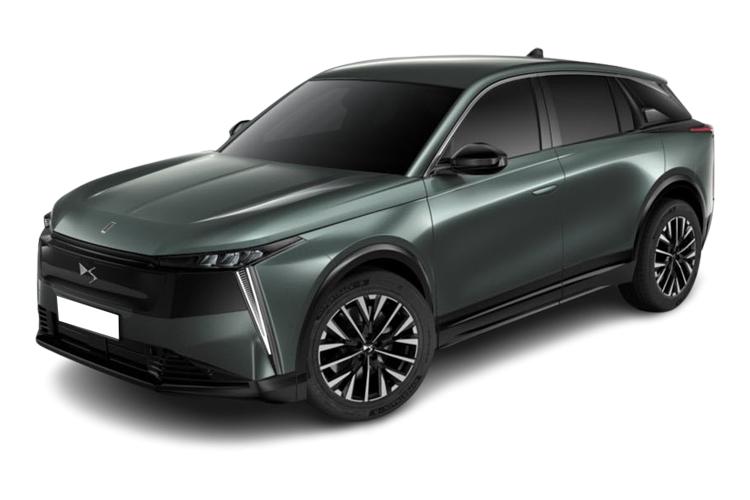
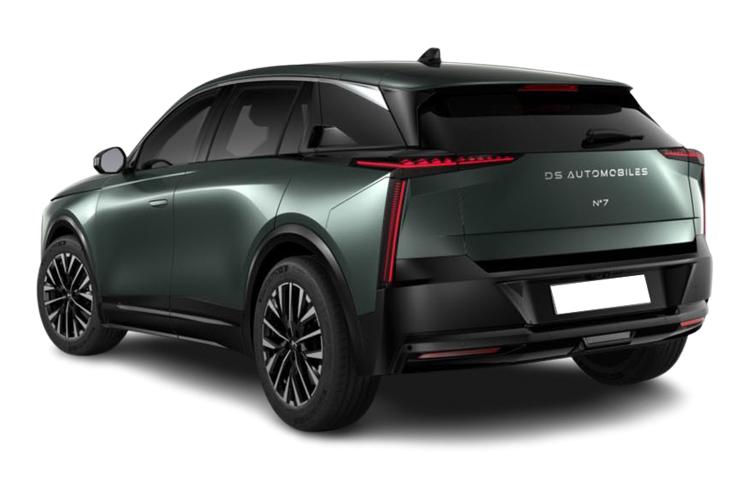
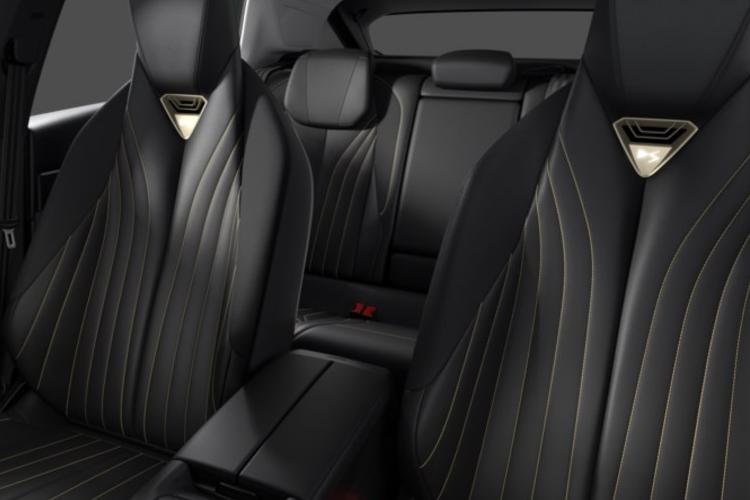
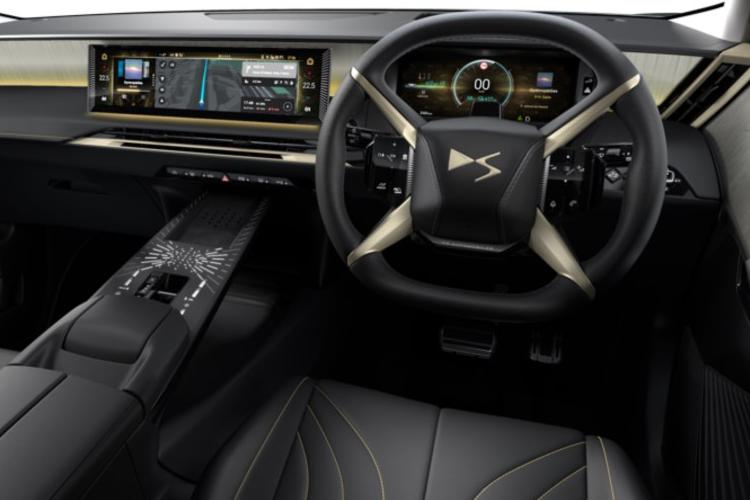
This second generation '7' shares virtually nothing with its predecessor except its market positioning and five-seat SUV format. As before, it seeks to occupy a market space somewhere in between the compact and mid-sized premium SUV sectors - so somewhere between an Audi Q3 and Q5, or the Mercedes GLA and GLC. Most of these models come with a choice of SUV or SUV Coupe body shapes, but there's just one body style available here. That's 4.66-metres in length, 7cm longer than before, though the 1.90-metre width and 1.63-metre height remain the same as with the old car. The height figure might surprise you given the swept-back silhouette; black cutaways on the roof give the impression that the No7 has a lower roof line than it actually does. The bold new angular look was inspired by the brand's 2020 DS Aero Sport Lounge concept. And shares most of its front end features with the larger DS No8 crossover, including its two-tone bonnet and (for the EV version only) illuminating grille. The V-shaped front lighting signature is certainly distinctive and there are big wheels of up to 21-inches in size. If you like all of that, then you might be even more charmed by the spectacularly unusual front-of-cabin design - another thing modelled on the No8. Cues carried forward from that car include the striking X-spoke steering wheel and the intricately-patterned dashboard panel that extends into the doors, making the driver feel cocooned. The screen tech is carried over too of course, which means a 10-inch driver's display and a separate 16-inch centre touchscreen monitor. Unlike Chinese rivals, a selection of physical controls feature around the centre console. The front seats can feature neck warmers and virtually all the materials used feel more up-market than is the case with other-branded versions of this Stellantis design. There's lovely mood lighting and striking gold accents, plus wooden and embossed aluminium dashboard inserts. And that trademark DS touch - seat leather in a 'watchstrap' design. Though the body length will allow for a third seating row, DS still doesn't want to provide one. But the new STLA Medium platform does allow for 5cm more wheelbase length, so rear seat leg room benefits accordingly and is more generous than in the No8. Unfortunately, something that platform doesn't allow for is rear seats that slide - and these ones don't recline either. Out back, there's a 560-litre boot (60-litres less than the No8), space that's reduced to 500-litres in the twin motor EV version. The rear seat backs split 40:20:40 if you need to extend that.
Prices start around £38,000 for the Hybrid and about £50,000 for the standard 230hp EV, with £53,000 required for the 245hp Long Range EV. There are three trim levels - 'Pallas', 'Etoile' and 'La Premiere'. Five so-called 'interior mood' packages are available, depending on the specification you choose, including a variety of leather and fabric combinations, the most extrovert being an 'Eternal Blue' alcantara. You can personalise your No7 with a deepblack contrasting roof colour or by an extended bi-tone colour that extends over the bonnet. Six shades are available, including a new colour for DS - 'Silk Green' - alongside 'Palladium Grey', 'Topaz Blue', 'Alabaster White', 'Crystal Pearl' and 'Perla Nera Black'. Available technology includes DS Pixelvision adaptive headlights, Active Scan Suspension, an Extended Head-up Display, 'DS Night Vision' and a digital rear view mirror. Drive assist functions are packaged up as part of the brand's 'Drive Assist 2.0' level 2 semi-autonomous system package. This controls distance to the vehicle in front and lane positioning, plus there's semi-automatic lane changing, and Adaptive Cruise Control with Stop&Go, a set-up that features the ability to adapt speed according to the road profile and speed limits. The system understands the type of road the car is travelling on, the speed limit, and also knows the radius of the next turn so it can adjust speed. This feature is also active at roundabouts and junctions.
Rapid DC charging speed doesn't tend to be a strongpoint of Stellantis models - and isn't here. The full-electric No7 DC-charges its French-made Nickel-Manganese-Cobalt batteries at up to 160kW - some distance behind the 200kW figure of the mechanically near-identical No8 crossover and way off many rivals; a Tesla Model Y, for instance, will charge at up to 250kW. DS says in response that the No7's charging curve is flatter than many of its competitors, in the early stages of charging (up to 55%) enabling the car to recover 118 miles of range for every 10 minutes of charge. A 20-80% public charge will take 27 minutes for the Long Range models. The No7 Hybrid returns 52.3mpg on the combined cycle and 121g/km of CO2. For AC home changing, the No7 has an 11kW on-board charger; in 97.2kWh form, the car needs 8 hours 50 minutes to go from 20 to 80% charge using a 7.4kW single-phase wallbox. This duration can be reduced to 6 hours if your home or office can use a three-phase 11kW wallbox. The No7 is fitted with intelligent battery management, allowing the charge to be automatically stopped at 80% to extend the performance and durability of the cells. All the powertrains have been programmed to reduce power outputs when charge levels are low.
We like the DS No7. You may not. It probably won't suit someone typically attracted by premium Teutonic brand - but then that's just the point here. This isn't just a French take on an Audi, a BMW or a Mercedes; it's something different. But different enough from the humbler, cheaper Vauxhall Grandland, Citroen C5 Aircross, Peugeot 3008 and Jeep Compass models it shares virtually all its engineering with? That's the question. This after all is where earlier DS 7 models fell short; the fancy packaging over very ordinary engineering felt somewhat skin-deep. The DS No7 though, feels like a much more serious effort at premium-ness. And yes, if it was our money, we'd probably pay the extra for it over its Vauxhall, Citroen, Peugeot and Jeep cousins. The problem for DS though, is that more aspirational badgework brings higher customer expectations. Expectations that the DS brand has always struggled to deliver on. The company needs a break-through product and this might not be it. But it's certainly a step in the right direction.
Data provided by CAP-HPI database - Ref# 110456
The DS No7 is the Gallic answer to what a premium mid-sized SUV should be. Jonathan Crouch takes a look.
The DS No7 gives a much-needed premium spin to familiar Stellantis mid-sized SUV mechanicals. And unlike the DS 7 models it succeeds, can also be had in full-electric form. Ever thought a premium Gallic brand might suit? If you haven't, DS hopes this car will make you think again.
Will Stellantis ever bring itself to part with the DS brand? What this ailing conglomerate doesn't need right now is a nameplate draining much-needed funds, yet that's what DS has largely done for its parent company since it was first founded as a stand-alone maker back in 2014 (prior to which it was simply an up-market Citroen trim level). DS continues today because the French motor industry - perhaps even the French nation - needs an up-market premium auto brand, just as every other G7 European nation has. Letting DS go to the wall like other premium segment marques have (Saab, Infiniti and so on) is unthinkable from a Gallic point of view. But might still happen if this car doesn't succeed, the DS No7. The very first unique product produced by DS after its establishment was a quirky but quite appealing aspirational mid-sized SUV called the DS7 Crossback, launched in 2019 and significantly updated in 2022. Neither version of the car sold particularly well (outside France) but with Stellantis nameplates Peugeot, Citroen, Vauxhall and Jeep all launching mid-sized SUVs in recent times based on a brand new STLA Medium platform, it wasn't a particularly big financial gamble for the conglomerate to use the same engineering and give the '7' model line another try. The car in question is now called the 'DS No7' and like its predecessor, it clothes its familiar mechanicals in a prettier party frock and offers a unique bejewelled cabin. That wasn't quite enough to properly position the old car as a really credible alternative to premium-badged German segment rivals. Will it be different this time round? Let's take a closer look.
There's been a complete change in terms of powertrains here over the previous DS 7 - though only because the borrowed Stellantis engineering demands it. That previous car came with a choice of diesel or petrol PHEV drivetrains. This one offers an entry-level 1.2-litre three cylinder mild hybrid petrol unit - pretty small for a car this big. Or - and this is the big change - a choice of full-EV variants. The electric DS No7 line-up kicks off with an FWD version using a 230hp front-mounted motor energised by a 73.4kWh battery offering a range of up to 322 miles. Ideally though, you'd stretch to a Long Range model with the larger 97.2kWh battery which in single motor form is supposed to offer an impressive-sounding range of up to 438 miles (only 6 miles short of the equivalent DS No8 crossover). That's due in part to a relatively sleek drag coefficient (for an SUV) of 0.26Cd. DS claims that this most frugal No7 can travel up to 280 miles even at motorway speeds. To cope with the extra battery weight, the single motor Long Range version's power output is raised to 245hp. Not available at launch but possibly in the future is the No7 in its top Long Range AWD form, in which guise the car comes with twin motors putting out a combined 345hp, though driving range falls to 422 miles. All models get the usual three-stage regenerative braking system that can be adjusted via paddles on the steering wheel and includes a fiercer 'One-Pedal' function. DS must have been tempted to make the entire No7 line-up all-electric (as the No8 model is), but in a hesitating EV market finally decided that a token combustion variant was necessary. You'd have thought the PHEV drivetrain from the equivalent Vauxhall Grandland, Citroen C5 Aircross or Peugeot 3008 models would have been the sensible thing to include, but instead (from launch anyway) the sole combustion unit on offer to No7 folk was the little 1.2-litre three cylinder turbocharged petrol engine we mentioned earlier, a powerplant that features on countless other (mostly much smaller ) Stellantis Group models. This combines a 28bhp electric motor and a six-speed dual clutch auto transmission and claims to be able to propel the car for up to 50% of the time on its battery in urban areas. Total output is 145hp. Whatever kind of powertrain you choose for your DS No7, in a car this kind you'd expect drive dynamics to be tuned for comfort. Unfortunately, the weight of the STLA Medium platform inhibits this, leading to the clunky ride we criticised in the Peugeot 3008 and Vauxhall Grandland versions of this design. A clever suspension tweak - Progressive Hydraulic Cushioning - alleviates this to some extent in the equivalent Citroen C5 Aircross, but the No7 unfortunately doesn't get that set-up. What it does have is an even more advanced suspension trick up its sleeve (though only for upper spec variants) - the 'Active Scan Suspension' set-up carried over from the old model. This features a camera monitoring the road surface that's able to adjust each shock absorber by a motorised solenoid valve to deal with road surface bumps.
This second generation '7' shares virtually nothing with its predecessor except its market positioning and five-seat SUV format. As before, it seeks to occupy a market space somewhere in between the compact and mid-sized premium SUV sectors - so somewhere between an Audi Q3 and Q5, or the Mercedes GLA and GLC. Most of these models come with a choice of SUV or SUV Coupe body shapes, but there's just one body style available here. That's 4.66-metres in length, 7cm longer than before, though the 1.90-metre width and 1.63-metre height remain the same as with the old car. The height figure might surprise you given the swept-back silhouette; black cutaways on the roof give the impression that the No7 has a lower roof line than it actually does. The bold new angular look was inspired by the brand's 2020 DS Aero Sport Lounge concept. And shares most of its front end features with the larger DS No8 crossover, including its two-tone bonnet and (for the EV version only) illuminating grille. The V-shaped front lighting signature is certainly distinctive and there are big wheels of up to 21-inches in size. If you like all of that, then you might be even more charmed by the spectacularly unusual front-of-cabin design - another thing modelled on the No8. Cues carried forward from that car include the striking X-spoke steering wheel and the intricately-patterned dashboard panel that extends into the doors, making the driver feel cocooned. The screen tech is carried over too of course, which means a 10-inch driver's display and a separate 16-inch centre touchscreen monitor. Unlike Chinese rivals, a selection of physical controls feature around the centre console. The front seats can feature neck warmers and virtually all the materials used feel more up-market than is the case with other-branded versions of this Stellantis design. There's lovely mood lighting and striking gold accents, plus wooden and embossed aluminium dashboard inserts. And that trademark DS touch - seat leather in a 'watchstrap' design. Though the body length will allow for a third seating row, DS still doesn't want to provide one. But the new STLA Medium platform does allow for 5cm more wheelbase length, so rear seat leg room benefits accordingly and is more generous than in the No8. Unfortunately, something that platform doesn't allow for is rear seats that slide - and these ones don't recline either. Out back, there's a 560-litre boot (60-litres less than the No8), space that's reduced to 500-litres in the twin motor EV version. The rear seat backs split 40:20:40 if you need to extend that.
Prices start around £38,000 for the Hybrid and about £50,000 for the standard 230hp EV, with £53,000 required for the 245hp Long Range EV. There are three trim levels - 'Pallas', 'Etoile' and 'La Premiere'. Five so-called 'interior mood' packages are available, depending on the specification you choose, including a variety of leather and fabric combinations, the most extrovert being an 'Eternal Blue' alcantara. You can personalise your No7 with a deepblack contrasting roof colour or by an extended bi-tone colour that extends over the bonnet. Six shades are available, including a new colour for DS - 'Silk Green' - alongside 'Palladium Grey', 'Topaz Blue', 'Alabaster White', 'Crystal Pearl' and 'Perla Nera Black'. Available technology includes DS Pixelvision adaptive headlights, Active Scan Suspension, an Extended Head-up Display, 'DS Night Vision' and a digital rear view mirror. Drive assist functions are packaged up as part of the brand's 'Drive Assist 2.0' level 2 semi-autonomous system package. This controls distance to the vehicle in front and lane positioning, plus there's semi-automatic lane changing, and Adaptive Cruise Control with Stop&Go, a set-up that features the ability to adapt speed according to the road profile and speed limits. The system understands the type of road the car is travelling on, the speed limit, and also knows the radius of the next turn so it can adjust speed. This feature is also active at roundabouts and junctions.
Rapid DC charging speed doesn't tend to be a strongpoint of Stellantis models - and isn't here. The full-electric No7 DC-charges its French-made Nickel-Manganese-Cobalt batteries at up to 160kW - some distance behind the 200kW figure of the mechanically near-identical No8 crossover and way off many rivals; a Tesla Model Y, for instance, will charge at up to 250kW. DS says in response that the No7's charging curve is flatter than many of its competitors, in the early stages of charging (up to 55%) enabling the car to recover 118 miles of range for every 10 minutes of charge. A 20-80% public charge will take 27 minutes for the Long Range models. The No7 Hybrid returns 52.3mpg on the combined cycle and 121g/km of CO2. For AC home changing, the No7 has an 11kW on-board charger; in 97.2kWh form, the car needs 8 hours 50 minutes to go from 20 to 80% charge using a 7.4kW single-phase wallbox. This duration can be reduced to 6 hours if your home or office can use a three-phase 11kW wallbox. The No7 is fitted with intelligent battery management, allowing the charge to be automatically stopped at 80% to extend the performance and durability of the cells. All the powertrains have been programmed to reduce power outputs when charge levels are low.
We like the DS No7. You may not. It probably won't suit someone typically attracted by premium Teutonic brand - but then that's just the point here. This isn't just a French take on an Audi, a BMW or a Mercedes; it's something different. But different enough from the humbler, cheaper Vauxhall Grandland, Citroen C5 Aircross, Peugeot 3008 and Jeep Compass models it shares virtually all its engineering with? That's the question. This after all is where earlier DS 7 models fell short; the fancy packaging over very ordinary engineering felt somewhat skin-deep. The DS No7 though, feels like a much more serious effort at premium-ness. And yes, if it was our money, we'd probably pay the extra for it over its Vauxhall, Citroen, Peugeot and Jeep cousins. The problem for DS though, is that more aspirational badgework brings higher customer expectations. Expectations that the DS brand has always struggled to deliver on. The company needs a break-through product and this might not be it. But it's certainly a step in the right direction.
83kW La Prima 44kWh 5dr Auto

POA
Business Lease Price per month (excl VAT) £180.37
294kW GT 89kWh 5dr Auto
POA
Business Lease Price per month (excl VAT) £541.71