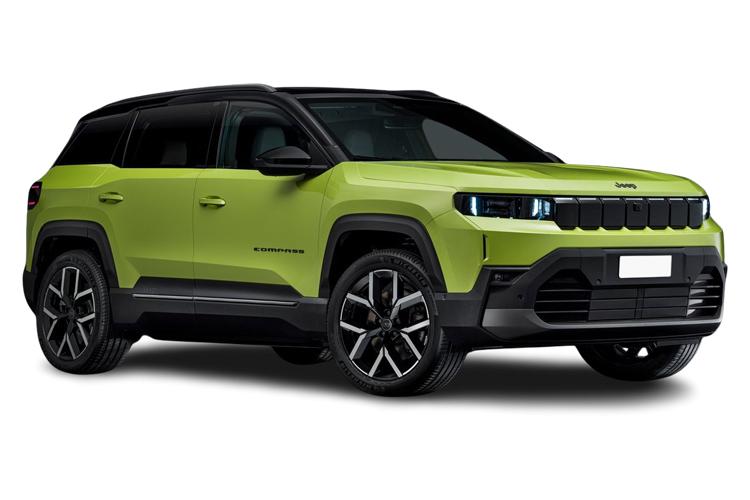
Images are for illustrative purposes only.

157kW First Edition 75kWh 5dr Auto
Need some assistance or advice? Call Us 01903 538835
This deal is a stock offer. The specification for this vehicle has been pre-selected.
Please submit a quote enquiry for full specification details.


The third generation Jeep Compass mid-sized SUV gains this full-EV variant. Jonathan Crouch drives it.
The Compass Electric is in most ways anything but what you expect a Jeep to be. But tries to reference its roots wherever it can to help it stand out in its over-crowded class.
It's easy to forget that across the Atlantic, the idea of a full-electric Jeep is still something of an anathema. In Europe though, EV sales are the staple driving force of the brand following the introduction of the electric Avenger compact SUV in 2023. Which paved the way for a more typically-sized Jeep EV and this is it, the Compass Electric. It's another European-only EV Jeep - and of course another significant one, even though at first glance, there's nothing particularly Jeep-like in its engineering. Here instead is another outing for the Stellantis STLA Medium platform we've already seen in current versions of the Vauxhall Grandland, the Citroen C5 Aircross, the Peugeot 3008 and the DS No7. But, as it claimed with the Avenger, Jeep says it's tailored the formula to suit its brand. Let's see.
The fully all-electric Compass will mainly be chosen with the 74kWh battery mated to a front motor offering 213hp. 0-62mph takes 8.5s en route to 112mph and there are three selectable levels of brake regen, operated by paddles behind the steering wheel, though even the fiercest of these doesn't offer the kind of arresting 'one-pedal'-style of retardation that you'll find with some rivals. Range is rated at up to 285 miles (though it'd be substantially less if you exercised the 1,230kg braked towing weight). If that range figure isn't enough, there's also a longer-range 98kWh EV variant (with a gutsier 230hp motor) offering up to 425 miles of range. Around town, the quite commanding driving position and the body's squared-off edges help to place the car in traffic and when parking. Ride quality has been a problem with the rival Peugeot and Vauxhall STLA-Medium architecture models we've tried; it's a bit better with this Jeep but still never really fully settles down over poorer surfaces. Refinement at speed is fine, but most rivals are quieter. On twistier roads, the steering's not bad, by unexceptional class standards; it's a variable rack that feeds in more steering angle as you turn. Let's finish with a look at the only Compass model that properly justifies its maker's famous badge. At the very top of the line-up is the 4xe 4WD Compass flagship model. We mentioned it earlier. This one gets a second 179hp electric motor on the rear axle that takes total power to 375hp, which makes this Europe's most powerful STLA-based Stellantis model yet. Jeep claims that the 4xe's rear motor can deliver up to 3,100Nm of torque and can pull the car up a 20% incline even if there's no traction for the front wheels. The 4xe has 10mm more suspension lift - to increase ground clearance (rated at 210mm) and give 28-degree approach, 31-degree departure and 17-degree breakover angles. Towing capacity is 1,300kg. The 4xe range is 372 miles.
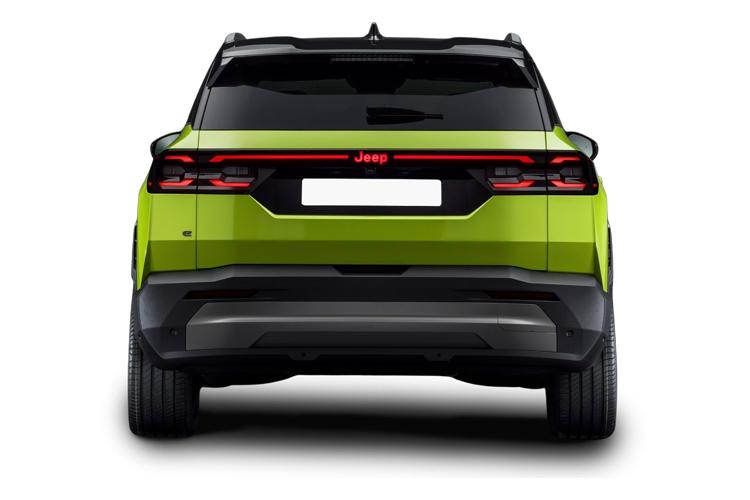
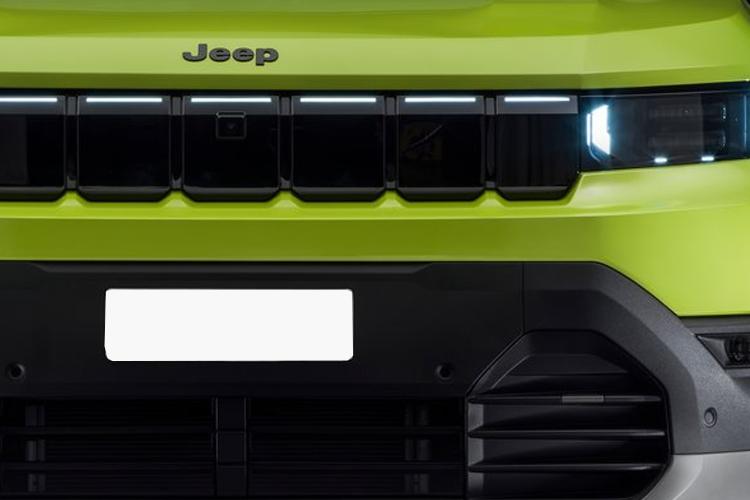
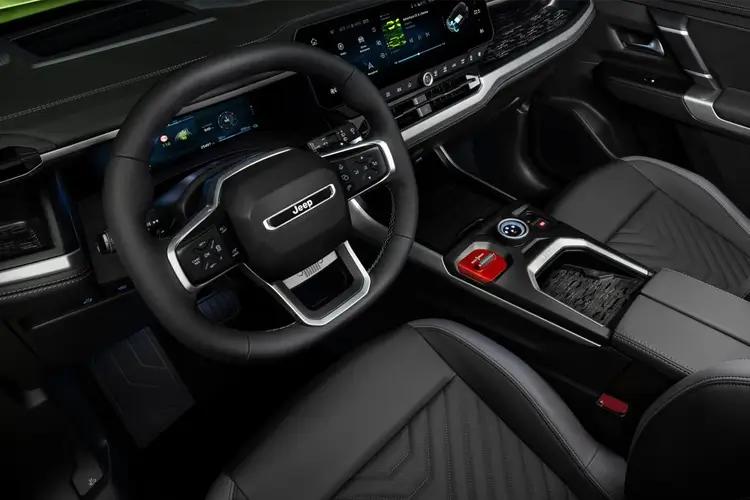
Apart from the badgework, there are few outward exterior signs of this Compass Electric's full-EV status. The Compass has always been very much a car for Europe, quite differently styled in each of its three generations. In styling this one, designer Danielle Calonaci was told to 'detoxify' the previous look (hence the new absence of chrome) but also make it bolder and more rugged; visually a logical step on from the smaller Avenger, with various traditional Jeep cues thrown in. As always with the brand, the most recognisable one of these is the seven-slot front grille - here re-imagined as a wrap-around panel. Squared-off wheel arches are another brand staple, but otherwise, there's little here that a US Jeep owner would recognise. European Jeep models of course run on totally different platforms - in this case, the STLA-Medium chassis used by this model's Stellantis cousins from Vauxhall, Citroen and Peugeot. But featuring here with a shorter 4,552mm-long body (though that's 150mm longer than the previous generation model). This is certainly a more eye-catching thing than its predecessor, with visual trinkets like a rear light bar with an illuminating badge. Jeep interior design has always been a bit hit-and-miss; this is much better, a huge step forward from any of the brand's previous models, with a big 16.0-inch central touchscreen, a 10.0-inch instrument display and a selection of touch controls. There's a rotating gear selector between the seats with a side-mounted Terrain Response controller for the drive modes. And in-cabin storage has been prioritised with 34-litres of stowage space available across the front of the car, including a shelf in front of the passenger and to the right of the steering wheel, plus a large bin under the main dashboard and a decently-sized centre console. The STLA-Medium platform has freed up much more space in the rear of this five-seat-only model. Jeep claims an extra 55mm of legroom. And out back, once the 40:20:40-split backrest is flattened, there's a 45-litre increase in boot space, with up to 550-litres available.
Following deduction of the available £1,500 government Electric Car Grant, Compass Electric pricing starts from around £35,500, only just above the e-Hybrid version. There's a choice of three trim levels -'Altitude', 'First Edition' and 'Summit'. You can also talk to your dealer about a 98kWh Long range Electric model, which wasn't available at the time of our test but for which you can expect to need a budget closer to £40,000. Jeep expects less of an uptake on the other two Compass plug-in powertrains, the 225hp Plug-in Hybrid - available in 'Altitude' and 'Summit' trims from around £37,000. And the top full-electric 4Xe version, offered in 'Upland' and 'Overland' trims priced from around £45,000, this the only Compass fitted with AWD and a variant which uses a 375hp twin motor EV drivetrain. Even base 'Altitude' spec gives you all-round parking sensors, a 16-inch Touchscreen infotainment system and a very complete package of Level 2 Autonomous Drive features. Other standard features include heat for the seats and steering wheel, dual-zone air conditioning, personalised ambient lighting, power-folding heated mirrors, passive entry/keyless go and a 10-inch instrument cluster. The fully-electric variant also includes pre-conditioning and a heat pump as standard. 'First Edition' trim gives you smarter 18-inch wheels, Matrix LED headlights. And 'Summit' spec adds larger 19-inch wheels and roof rails. Customers can pick from two optional packs. The 'Convenience Pack' includes a 360-degree camera, lateral parking sensors and blind spot monitoring, plus LED fog lamps, a handsfree powered tailgate and a wireless 'phone charger. The 'Premium Pack' adds a premium 9-speaker Focal audio system, a dual-pane sunroof and polychromatic ambient lighting. On fully electric variants, an optional on-board 22kW charger is also available.
With its 400V system, the Compass EV can charge at up to 160kW, a rather modest figure which allows for 20-80% charge in 31 minutes, with a charging rate of 2.4kWh per minute at its peak, at which point 62 miles of range are added every 10 minutes. For some reason, DC charging is fractionally quicker if you've a Compass Electric with the larger 98kWh battery - or the top 4xe version. When AC charging a 74kWh Compass Electric at home, a 7.4kW wallbox requires around 12 hours for full battery replenishment. You could reduce that time to about 8 hours if you're able to use a three-phase 11kW AC wallbox. For the Long Range 98kWh Electric model, the respective AC charging times are 14 hours and 10 hours 45 minutes. Via a provided smartphone app or by using the vehicle's touchscreen, owners can schedule a pre-conditioning wake-up time for the battery. This means that the cells can be at the optimal temperature for efficiency from the time you start up, plus of course the interior can also be pre-cooled or pre-heated too. The Compass EV's battery comes with an eight year / 100,000 warranty for 70% of its capacity. All Compass models come with the usual unremarkable Stellantis Group three year / 60,000 mile warranty.
You can't imagine that the Compass Electric would sell very well in America or to diehard Jeep folk, even in off-road 4xe form. But since it won't be offered Stateside and isn't targeted at the grizzly bear/bowling ball set, that hardly matters. The customers it is targeted at - those seeking a slightly more charismatic, adventurous take on what a mid-sized full-electric family SUV should be - might well like it in sufficient numbers to satisfy the brand's modest sales targets for this car. Jeep might insist that this model has some degree of off-road prowess, but it would be a brave family buyer who drops £40,000 or more on this car and then tries to put that to the test. Like its Stellantis cousins, it's hobbled a bit (mainly in EV range) by the STLA platform's weight. But it's easier to live with and will be better to drive than the vanilla Chinese segment alternatives. And is a bit more interesting in its looks and packaging than most of the other European, Japanese and Korean class options. It should all be enough to guarantee this car a little niche in this over-crowded class.
Data provided by CAP-HPI database - Ref# 107961
The third generation Jeep Compass mid-sized SUV gains this full-EV variant. Jonathan Crouch drives it.
The Compass Electric is in most ways anything but what you expect a Jeep to be. But tries to reference its roots wherever it can to help it stand out in its over-crowded class.
It's easy to forget that across the Atlantic, the idea of a full-electric Jeep is still something of an anathema. In Europe though, EV sales are the staple driving force of the brand following the introduction of the electric Avenger compact SUV in 2023. Which paved the way for a more typically-sized Jeep EV and this is it, the Compass Electric. It's another European-only EV Jeep - and of course another significant one, even though at first glance, there's nothing particularly Jeep-like in its engineering. Here instead is another outing for the Stellantis STLA Medium platform we've already seen in current versions of the Vauxhall Grandland, the Citroen C5 Aircross, the Peugeot 3008 and the DS No7. But, as it claimed with the Avenger, Jeep says it's tailored the formula to suit its brand. Let's see.
The fully all-electric Compass will mainly be chosen with the 74kWh battery mated to a front motor offering 213hp. 0-62mph takes 8.5s en route to 112mph and there are three selectable levels of brake regen, operated by paddles behind the steering wheel, though even the fiercest of these doesn't offer the kind of arresting 'one-pedal'-style of retardation that you'll find with some rivals. Range is rated at up to 285 miles (though it'd be substantially less if you exercised the 1,230kg braked towing weight). If that range figure isn't enough, there's also a longer-range 98kWh EV variant (with a gutsier 230hp motor) offering up to 425 miles of range. Around town, the quite commanding driving position and the body's squared-off edges help to place the car in traffic and when parking. Ride quality has been a problem with the rival Peugeot and Vauxhall STLA-Medium architecture models we've tried; it's a bit better with this Jeep but still never really fully settles down over poorer surfaces. Refinement at speed is fine, but most rivals are quieter. On twistier roads, the steering's not bad, by unexceptional class standards; it's a variable rack that feeds in more steering angle as you turn. Let's finish with a look at the only Compass model that properly justifies its maker's famous badge. At the very top of the line-up is the 4xe 4WD Compass flagship model. We mentioned it earlier. This one gets a second 179hp electric motor on the rear axle that takes total power to 375hp, which makes this Europe's most powerful STLA-based Stellantis model yet. Jeep claims that the 4xe's rear motor can deliver up to 3,100Nm of torque and can pull the car up a 20% incline even if there's no traction for the front wheels. The 4xe has 10mm more suspension lift - to increase ground clearance (rated at 210mm) and give 28-degree approach, 31-degree departure and 17-degree breakover angles. Towing capacity is 1,300kg. The 4xe range is 372 miles.
Apart from the badgework, there are few outward exterior signs of this Compass Electric's full-EV status. The Compass has always been very much a car for Europe, quite differently styled in each of its three generations. In styling this one, designer Danielle Calonaci was told to 'detoxify' the previous look (hence the new absence of chrome) but also make it bolder and more rugged; visually a logical step on from the smaller Avenger, with various traditional Jeep cues thrown in. As always with the brand, the most recognisable one of these is the seven-slot front grille - here re-imagined as a wrap-around panel. Squared-off wheel arches are another brand staple, but otherwise, there's little here that a US Jeep owner would recognise. European Jeep models of course run on totally different platforms - in this case, the STLA-Medium chassis used by this model's Stellantis cousins from Vauxhall, Citroen and Peugeot. But featuring here with a shorter 4,552mm-long body (though that's 150mm longer than the previous generation model). This is certainly a more eye-catching thing than its predecessor, with visual trinkets like a rear light bar with an illuminating badge. Jeep interior design has always been a bit hit-and-miss; this is much better, a huge step forward from any of the brand's previous models, with a big 16.0-inch central touchscreen, a 10.0-inch instrument display and a selection of touch controls. There's a rotating gear selector between the seats with a side-mounted Terrain Response controller for the drive modes. And in-cabin storage has been prioritised with 34-litres of stowage space available across the front of the car, including a shelf in front of the passenger and to the right of the steering wheel, plus a large bin under the main dashboard and a decently-sized centre console. The STLA-Medium platform has freed up much more space in the rear of this five-seat-only model. Jeep claims an extra 55mm of legroom. And out back, once the 40:20:40-split backrest is flattened, there's a 45-litre increase in boot space, with up to 550-litres available.
Following deduction of the available £1,500 government Electric Car Grant, Compass Electric pricing starts from around £35,500, only just above the e-Hybrid version. There's a choice of three trim levels -'Altitude', 'First Edition' and 'Summit'. You can also talk to your dealer about a 98kWh Long range Electric model, which wasn't available at the time of our test but for which you can expect to need a budget closer to £40,000. Jeep expects less of an uptake on the other two Compass plug-in powertrains, the 225hp Plug-in Hybrid - available in 'Altitude' and 'Summit' trims from around £37,000. And the top full-electric 4Xe version, offered in 'Upland' and 'Overland' trims priced from around £45,000, this the only Compass fitted with AWD and a variant which uses a 375hp twin motor EV drivetrain. Even base 'Altitude' spec gives you all-round parking sensors, a 16-inch Touchscreen infotainment system and a very complete package of Level 2 Autonomous Drive features. Other standard features include heat for the seats and steering wheel, dual-zone air conditioning, personalised ambient lighting, power-folding heated mirrors, passive entry/keyless go and a 10-inch instrument cluster. The fully-electric variant also includes pre-conditioning and a heat pump as standard. 'First Edition' trim gives you smarter 18-inch wheels, Matrix LED headlights. And 'Summit' spec adds larger 19-inch wheels and roof rails. Customers can pick from two optional packs. The 'Convenience Pack' includes a 360-degree camera, lateral parking sensors and blind spot monitoring, plus LED fog lamps, a handsfree powered tailgate and a wireless 'phone charger. The 'Premium Pack' adds a premium 9-speaker Focal audio system, a dual-pane sunroof and polychromatic ambient lighting. On fully electric variants, an optional on-board 22kW charger is also available.
With its 400V system, the Compass EV can charge at up to 160kW, a rather modest figure which allows for 20-80% charge in 31 minutes, with a charging rate of 2.4kWh per minute at its peak, at which point 62 miles of range are added every 10 minutes. For some reason, DC charging is fractionally quicker if you've a Compass Electric with the larger 98kWh battery - or the top 4xe version. When AC charging a 74kWh Compass Electric at home, a 7.4kW wallbox requires around 12 hours for full battery replenishment. You could reduce that time to about 8 hours if you're able to use a three-phase 11kW AC wallbox. For the Long Range 98kWh Electric model, the respective AC charging times are 14 hours and 10 hours 45 minutes. Via a provided smartphone app or by using the vehicle's touchscreen, owners can schedule a pre-conditioning wake-up time for the battery. This means that the cells can be at the optimal temperature for efficiency from the time you start up, plus of course the interior can also be pre-cooled or pre-heated too. The Compass EV's battery comes with an eight year / 100,000 warranty for 70% of its capacity. All Compass models come with the usual unremarkable Stellantis Group three year / 60,000 mile warranty.
You can't imagine that the Compass Electric would sell very well in America or to diehard Jeep folk, even in off-road 4xe form. But since it won't be offered Stateside and isn't targeted at the grizzly bear/bowling ball set, that hardly matters. The customers it is targeted at - those seeking a slightly more charismatic, adventurous take on what a mid-sized full-electric family SUV should be - might well like it in sufficient numbers to satisfy the brand's modest sales targets for this car. Jeep might insist that this model has some degree of off-road prowess, but it would be a brave family buyer who drops £40,000 or more on this car and then tries to put that to the test. Like its Stellantis cousins, it's hobbled a bit (mainly in EV range) by the STLA platform's weight. But it's easier to live with and will be better to drive than the vanilla Chinese segment alternatives. And is a bit more interesting in its looks and packaging than most of the other European, Japanese and Korean class options. It should all be enough to guarantee this car a little niche in this over-crowded class.
G 580 432kW EQ Tech AMG Line Prem+ 116kWh 5dr Auto

POA
POA