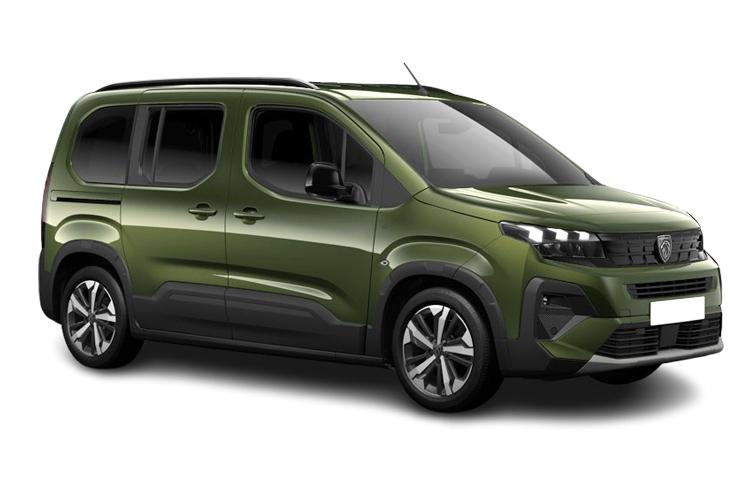
Images are for illustrative purposes only.
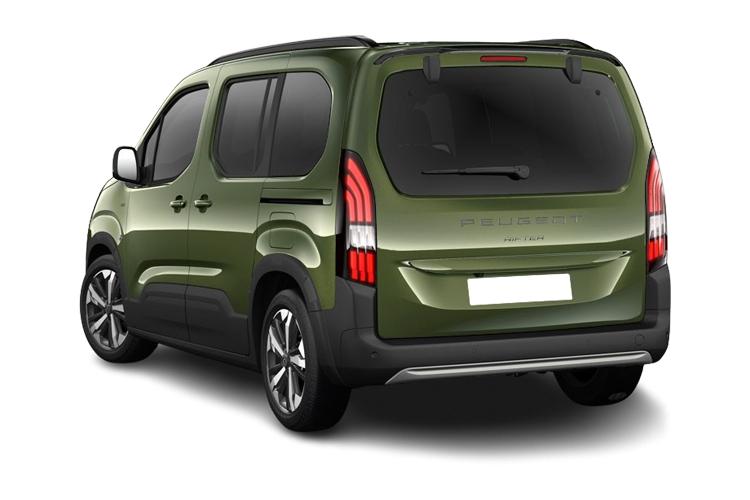

100kW Allure 50kWh 5dr Auto
Need some assistance or advice? Call Us 01903 538835


By Jonathan Crouch
If you can afford the higher asking price and can cope with the 172 mile driving range, then there aren't too many other downsides in opting for the original version of Peugeot's fully electric e-Rifter small MPV, which by 2021 was the only Rifter variant still on offer. As a used buy, it certainly might be tempting option if you're looking for a full-electric compact family car and don't want a compact SUV. Here, there was the option of a 7-seat cabin too, which is rare to find in an EV of this size. Except with the Citroen and Vauxhall models than share this one's design.
5dr SUV (EV)
The segment for compact People Carriers gained something of a fresh lease of life in this century's third decade, courtesy of EV power. What used to be called the PSA Group doggedly continued to sell small MPVs in the century's second decade as sales in this sector declined, but by 2021 the conglomerate, by then part of Stellantis, started to reap the benefit, launching fully electrified versions of the Citroen Berlingo, the Vauxhall Combo and the subject of here, Peugeot's e-Rifter. As with those two in-house rivals, it got the 50kWh battery that by 2021 Peugeot, Citroen and Vauxhall seemed to fit to every EV they made, even the biggest MPVs. Here of course, a battery of that size was far more appropriate and it was built into the car in a way that didn't compromise cabin space. The e-Rifter was significantly facelifted and given a longer driving range in mid 2024, but it's the earlier 2021-2023-era models we look at here.
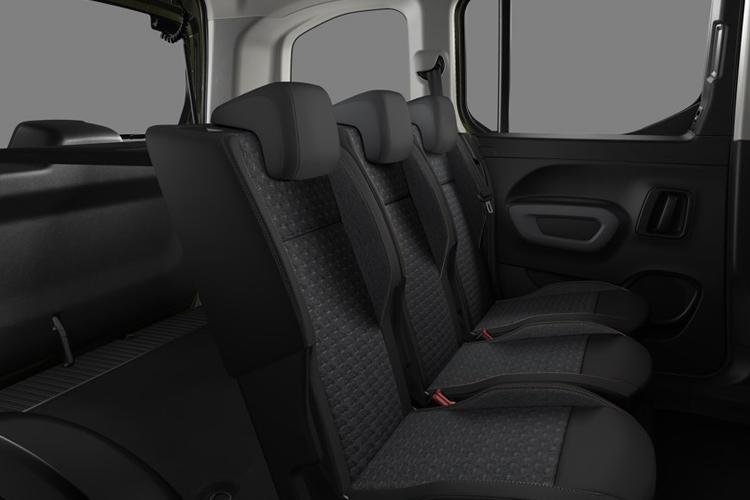
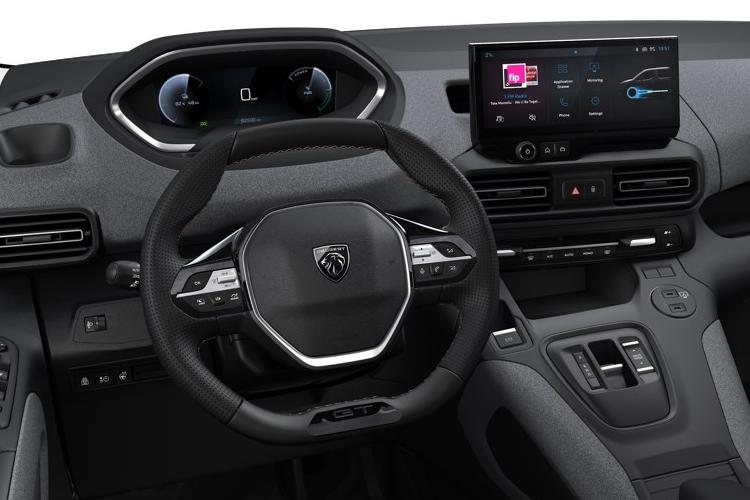
There's very little outward differentiation to identify this particular Rifter's all-electric status. Unless you notice the lack of tailpipes and the addition of a charging flap, extra badging and trim accents are the only giveaways. You'll really need the extra embellishment of the top 'GT' trim level though, if you want to distract the attention of passers-by from the fact that all you've actually really got here is a Peugeot Partner van with extra seats and windows. You get a choice of wheelbases - 'M' (for 'Medium'); or 'XL', the latter enabling the fitment of a third row of seats. At the wheel, at first glance anyway, it's much as in the old combustion-powered conventional Rifter (or indeed a Peugeot Partner van). That means that there's the brand's usual 'i-Cockpit' design, which uses this much smaller-than-normal little three-spoke wheel. You view the dials over the top of its rim, rather than conventionally through its spokes. Once you've got used to that, if you look a little closer around, you'll start to see some of this EV variant's model-specific differences. This little EV drive toggle switch, for instance, that takes the place of the usual gear selector. And of course there are EV-specific features on both of the provided displays. Let's start with the 10-inch instrument screen you view above the wheel rim, which in its standard layout has a battery indicator on the left, a digital speedo in the middle and a 'Power/Eco/Charge' drive meter on the right. Using this little rotary controller on the left hand steering wheel spoke, you can alter the screen layout through various settings; 'Energy', 'Dials', 'Driving', 'Navigation', 'Minimal' and 'Personal'. Whatever you choose, the resolution is sharply defined and easy to read. Which can't really also be said for the central 8-inch infotainment display. Still, at least it has a physical volume dial and, more importantly, it's not burdened with the climate controls (which are separated out further down the centre stack). We've saved arguably the best bit though, until last: cabin practicality. If you were to add up the capacity of all the 28 different nooks and crannies available within the interior of this Rifter, you'd arrive at a figure of 167-litres - about as much as you'd get in the entire boot of some city cars. Enough on what the front of the cabin's like: let's consider the second row. Both short and long wheelbase e-Rifter models offer access to this part of the car via sliding side doors. The sliding doors are rather heavy to close from the inside and this format means you can't have door pockets either. Still, on the plus side, the second row offers enough space to suit a wide variety of passenger shapes and sizes. Because the battery pack is mounted beneath this MPV model's floor, cabin space is not compromised at all over comparable combustion engined Rifter models. So there are vast standards of headroom and because the centre transmission tunnel is virtually non-existent, it's straightforward to accommodate three fully-sized adults if need be. If you're able to stretch to the top-spec 'GT' level of trim, you'll get the three individual rear seats that really ought to be optional further down the range. With base 'Allure Premium'-spec though, you'll be stuck with the conventional fixed bench, which really doesn't do very much at all, unable to slide or recline in the way you'd hope an MPV model rear seat might. All e-Rifters get these aircraft-style seatback tables with cup holder points, but you don't get the useful under-floor storage compartments that used to feature on the old combustion models; blame the bulky EV powertrain below you for that. Twin vents are provided back here - and you get a separate climate control if you've a model with the dual-zone system fitted. Lower down, there's a USB socket too. And that's about it, assuming you've gone for a 'Standard'-length five-seat short wheelbase Rifter. Were we to be buying this Peugeot though, we'd be tempted to pay the small amount extra for the 'Long' body style with its two extra boot-mounted chairs. The fact that these sit within a spacious 4.75m body shape means that they can, at a pitch, be quite comfortably used by adults on short-to-medium-length journeys. It's just another example of this Peugeot's flexibility. Let's consider boot space. Whatever way you opt for this Rifter, its cargo area will be vast and the clever battery pack under-floor placement we mentioned earlier means that the capacity figures are unaltered from those of the previous combustion-powered models, though there's no storage space beneath the floor in this one. But you don't really need it because even the 5-seat short wheelbase 'Standard' length variant can swallow 775-litres in its boot, while the lengthier wheelbase 'Long' version has a capacity of up to 1,050-litres. The parcel shelf at the back can take up to 25kg of weight (so, for instance, you could put the dog on top of the shopping). Fold down the 60:40-split rear bench and up to 3,000 litres is freed up; with a 'Long' wheelbase model, it'd be up to 4,000-litres with both the back seating rows folded. In addition, with either body style, if you're taking really long items, the front passenger seat can be folded flat, allowing items like surfboards of up to 3,050mm long to be taken inside 'Long'-spec models.
Please contact us for an exact up-to-date valuation.
As with other small MPVs, check for child damage inside and alloy wheel scuffs outside. And of course you'll want a fully stamped up service record. What else? Well examine for flaking of paint on the bumpers and check that the air conditioning works and that the pixels on the centre display are all good. Also check for rear bumper scrapes. Finally check that the Bluetooth pairs reliably with your phone handset. Electrical glitches are relatively common, so make sure everything electrical in the car works and double-check that there are no unexplained warning lights on the dashboard. Peugeot's infotainment touchscreen software can sometimes cause the monitor to freeze or fail completely. A software reset may solve the problem, but some owners have had to replace the entire unit, which is not a cheap operation. The drive battery in used e-Rifter models should have quite a bit of life in it, unless you happen to be looking at one of the very earliest '21-plate versions. When the battery is on its way out, you'll obviously find that it won't go as far on each charge - and when it starts to run low on charge, you'll find that the car will particularly start to struggle going uphill. When it gets old, the lithium-ion battery used here can suffer from the ionised liquid in the battery freezing certain cells; those cells are then unable to receive charge. Before going to all that trouble though, make sure the issue really is the battery. If the car won't charge, it could be a problem with your home electrics (or those at the public charge point you're using). Check the charge light to make sure that electricity really is going through the charge port. And make sure there really is charge in the socket you're using to power from - plug something else into it to see - say, your 'phone. If that charges OK, it could be that your charging cable is demanding too much power, so try another power source. Another problem could be that the circuit may have tripped due to a circuit overload. Or perhaps there could be a problem with the charge cable: this needs to be cared for properly. Repeatedly driving over it (as previous owners may conceivably have done) will damage it eventually. Make sure you do a charge-up before signing for the car you're looking at. When you do this, make sure that when you plug in to start the charge cycle you hear the charge port and the cable locking and engaging as they should; that's all part of the charger basically confirming with the car's onboard computer that everything's good to go before releasing power. But if the charging cable fails to lock as it should, then that won't happen. If there is a failure to lock, the issue could be actuator failure, caused by a blown fuse.
(approx based on a 2021 e-Rifter excl. VAT - autopartspro.co.uk) A pair of front brake pads are between £18-£11 depending on brand. A pair of rear brake pads are between £23-£58. A pair of front brake discs start in the £30-£38 bracket; rears are between £23-£34. Pollen filters cost around £9-£50 and wiper blades cost around £6-£9.
So what's it like? Well you sit quite high and SUV-like in front of a 10-inch instrument screen that, unusually, you view over the steering wheel rim rather than through it. Pressing the start button gets you a beep and a green ready message on the display ahead. Unlike some EVs, this one doesn't spring away from rest in a flurry of torque; it's all much more linear and combustion-like, whichever of the available drive modes you select. There are three - 'ECO', 'Normal' and 'Power'. You won't want to spend too long in 'ECO', unless you really are eeking out battery capacity, because it reduces the powertrain's normal 134bhp output to just 80bhp and also restricts the climate system to conserve power. Peugeot suggests that you do most of your driving in the 'Normal' setting, which increases the motor output to 107bhp. The top 'Power' mode isn't really intended for sporty driving but for situations when you're carrying heavy loads. The powertrain also has a 'B' setting which increases the level of regenerative braking to a point where the car slows so much when you come off throttle that you'll very rarely need to use the brake, unless you're coming to a complete stop. Other than that, there's not too much to get used to in driving an e-Rifter. The little steering wheel feels completely at odds with the car's utilitarian vibe and tall, tippy shape; you certainly wouldn't be encouraged in any way to go throwing the thing around, even if you were late for the school play or had left dinner burning in the oven. Anyway, that would decimate your driving range, which was claimed at 172 miles for the Standard length model, around 30 miles less than the full-electric Vauxhall Corsa and Peugeot 208 superminis of the period that also used this battery. Like all electric vehicles, this one has a bit of a weight problem - that drivetrain adds over 300kgs of bulk - but that arguably helps the e-Rifter when it comes to ride quality; you'll feel things like speed humps keenly, but at speed on the open road, it handles tarmac tears a little better than its combustion cousins. This e-Rifter feels really at home in an urban environment - surprisingly really because it's quite a large car, especially in 'Long' wheelbase form. But you'll feel really confident in it on the school run because all-round visibility is great, the steering is light and as we've said, the suspension deals with poorer surfaces quite well. Parking's easy because rear sensors and a reversing camera are standard-fit across the range. And charging: what about that? Well, as you'd want, the e-Rifter supports up to 100kW rapid (DC) charging, with an 80% re-charge taking less than 30 minutes, while a full charge from a 7.4 kW single-phase wallbox takes 7.5 hours thanks to the 7.4kW on-board charger.
There must be plenty of people out there who want a family-shaped compact electric vehicle from the 2021-2023 era - maybe as a second car - but don't want an SUV. It would have to be realistically priced, have an acceptable driving range and not look too van-like. This original e-Rifter, to our eyes anyway, ticks all these boxes. For whatever reason, with the right spec in place, there's a bit less of a whiff of LCV here than there is with this model's two Stellantis Group cousins from this period, the Vauxhall Combo-e Life and the Citroen's e-Berlingo. And if you take up the long wheelbase version's offered option of having 7 seats, then this Peugeot has a big advantage over a comparably sized (and probably pricier) all-electric compact SUV. Plus this Rifter can be a van if you need it to be. Jack of all trades then; and master of one - the art of by-passing fuel stations.
Data provided by CAP-HPI database - Ref# 100862
By Jonathan Crouch
If you can afford the higher asking price and can cope with the 172 mile driving range, then there aren't too many other downsides in opting for the original version of Peugeot's fully electric e-Rifter small MPV, which by 2021 was the only Rifter variant still on offer. As a used buy, it certainly might be tempting option if you're looking for a full-electric compact family car and don't want a compact SUV. Here, there was the option of a 7-seat cabin too, which is rare to find in an EV of this size. Except with the Citroen and Vauxhall models than share this one's design.
5dr SUV (EV)
The segment for compact People Carriers gained something of a fresh lease of life in this century's third decade, courtesy of EV power. What used to be called the PSA Group doggedly continued to sell small MPVs in the century's second decade as sales in this sector declined, but by 2021 the conglomerate, by then part of Stellantis, started to reap the benefit, launching fully electrified versions of the Citroen Berlingo, the Vauxhall Combo and the subject of here, Peugeot's e-Rifter. As with those two in-house rivals, it got the 50kWh battery that by 2021 Peugeot, Citroen and Vauxhall seemed to fit to every EV they made, even the biggest MPVs. Here of course, a battery of that size was far more appropriate and it was built into the car in a way that didn't compromise cabin space. The e-Rifter was significantly facelifted and given a longer driving range in mid 2024, but it's the earlier 2021-2023-era models we look at here.
There's very little outward differentiation to identify this particular Rifter's all-electric status. Unless you notice the lack of tailpipes and the addition of a charging flap, extra badging and trim accents are the only giveaways. You'll really need the extra embellishment of the top 'GT' trim level though, if you want to distract the attention of passers-by from the fact that all you've actually really got here is a Peugeot Partner van with extra seats and windows. You get a choice of wheelbases - 'M' (for 'Medium'); or 'XL', the latter enabling the fitment of a third row of seats. At the wheel, at first glance anyway, it's much as in the old combustion-powered conventional Rifter (or indeed a Peugeot Partner van). That means that there's the brand's usual 'i-Cockpit' design, which uses this much smaller-than-normal little three-spoke wheel. You view the dials over the top of its rim, rather than conventionally through its spokes. Once you've got used to that, if you look a little closer around, you'll start to see some of this EV variant's model-specific differences. This little EV drive toggle switch, for instance, that takes the place of the usual gear selector. And of course there are EV-specific features on both of the provided displays. Let's start with the 10-inch instrument screen you view above the wheel rim, which in its standard layout has a battery indicator on the left, a digital speedo in the middle and a 'Power/Eco/Charge' drive meter on the right. Using this little rotary controller on the left hand steering wheel spoke, you can alter the screen layout through various settings; 'Energy', 'Dials', 'Driving', 'Navigation', 'Minimal' and 'Personal'. Whatever you choose, the resolution is sharply defined and easy to read. Which can't really also be said for the central 8-inch infotainment display. Still, at least it has a physical volume dial and, more importantly, it's not burdened with the climate controls (which are separated out further down the centre stack). We've saved arguably the best bit though, until last: cabin practicality. If you were to add up the capacity of all the 28 different nooks and crannies available within the interior of this Rifter, you'd arrive at a figure of 167-litres - about as much as you'd get in the entire boot of some city cars. Enough on what the front of the cabin's like: let's consider the second row. Both short and long wheelbase e-Rifter models offer access to this part of the car via sliding side doors. The sliding doors are rather heavy to close from the inside and this format means you can't have door pockets either. Still, on the plus side, the second row offers enough space to suit a wide variety of passenger shapes and sizes. Because the battery pack is mounted beneath this MPV model's floor, cabin space is not compromised at all over comparable combustion engined Rifter models. So there are vast standards of headroom and because the centre transmission tunnel is virtually non-existent, it's straightforward to accommodate three fully-sized adults if need be. If you're able to stretch to the top-spec 'GT' level of trim, you'll get the three individual rear seats that really ought to be optional further down the range. With base 'Allure Premium'-spec though, you'll be stuck with the conventional fixed bench, which really doesn't do very much at all, unable to slide or recline in the way you'd hope an MPV model rear seat might. All e-Rifters get these aircraft-style seatback tables with cup holder points, but you don't get the useful under-floor storage compartments that used to feature on the old combustion models; blame the bulky EV powertrain below you for that. Twin vents are provided back here - and you get a separate climate control if you've a model with the dual-zone system fitted. Lower down, there's a USB socket too. And that's about it, assuming you've gone for a 'Standard'-length five-seat short wheelbase Rifter. Were we to be buying this Peugeot though, we'd be tempted to pay the small amount extra for the 'Long' body style with its two extra boot-mounted chairs. The fact that these sit within a spacious 4.75m body shape means that they can, at a pitch, be quite comfortably used by adults on short-to-medium-length journeys. It's just another example of this Peugeot's flexibility. Let's consider boot space. Whatever way you opt for this Rifter, its cargo area will be vast and the clever battery pack under-floor placement we mentioned earlier means that the capacity figures are unaltered from those of the previous combustion-powered models, though there's no storage space beneath the floor in this one. But you don't really need it because even the 5-seat short wheelbase 'Standard' length variant can swallow 775-litres in its boot, while the lengthier wheelbase 'Long' version has a capacity of up to 1,050-litres. The parcel shelf at the back can take up to 25kg of weight (so, for instance, you could put the dog on top of the shopping). Fold down the 60:40-split rear bench and up to 3,000 litres is freed up; with a 'Long' wheelbase model, it'd be up to 4,000-litres with both the back seating rows folded. In addition, with either body style, if you're taking really long items, the front passenger seat can be folded flat, allowing items like surfboards of up to 3,050mm long to be taken inside 'Long'-spec models.
Please contact us for an exact up-to-date valuation.
As with other small MPVs, check for child damage inside and alloy wheel scuffs outside. And of course you'll want a fully stamped up service record. What else? Well examine for flaking of paint on the bumpers and check that the air conditioning works and that the pixels on the centre display are all good. Also check for rear bumper scrapes. Finally check that the Bluetooth pairs reliably with your phone handset. Electrical glitches are relatively common, so make sure everything electrical in the car works and double-check that there are no unexplained warning lights on the dashboard. Peugeot's infotainment touchscreen software can sometimes cause the monitor to freeze or fail completely. A software reset may solve the problem, but some owners have had to replace the entire unit, which is not a cheap operation. The drive battery in used e-Rifter models should have quite a bit of life in it, unless you happen to be looking at one of the very earliest '21-plate versions. When the battery is on its way out, you'll obviously find that it won't go as far on each charge - and when it starts to run low on charge, you'll find that the car will particularly start to struggle going uphill. When it gets old, the lithium-ion battery used here can suffer from the ionised liquid in the battery freezing certain cells; those cells are then unable to receive charge. Before going to all that trouble though, make sure the issue really is the battery. If the car won't charge, it could be a problem with your home electrics (or those at the public charge point you're using). Check the charge light to make sure that electricity really is going through the charge port. And make sure there really is charge in the socket you're using to power from - plug something else into it to see - say, your 'phone. If that charges OK, it could be that your charging cable is demanding too much power, so try another power source. Another problem could be that the circuit may have tripped due to a circuit overload. Or perhaps there could be a problem with the charge cable: this needs to be cared for properly. Repeatedly driving over it (as previous owners may conceivably have done) will damage it eventually. Make sure you do a charge-up before signing for the car you're looking at. When you do this, make sure that when you plug in to start the charge cycle you hear the charge port and the cable locking and engaging as they should; that's all part of the charger basically confirming with the car's onboard computer that everything's good to go before releasing power. But if the charging cable fails to lock as it should, then that won't happen. If there is a failure to lock, the issue could be actuator failure, caused by a blown fuse.
(approx based on a 2021 e-Rifter excl. VAT - autopartspro.co.uk) A pair of front brake pads are between £18-£11 depending on brand. A pair of rear brake pads are between £23-£58. A pair of front brake discs start in the £30-£38 bracket; rears are between £23-£34. Pollen filters cost around £9-£50 and wiper blades cost around £6-£9.
So what's it like? Well you sit quite high and SUV-like in front of a 10-inch instrument screen that, unusually, you view over the steering wheel rim rather than through it. Pressing the start button gets you a beep and a green ready message on the display ahead. Unlike some EVs, this one doesn't spring away from rest in a flurry of torque; it's all much more linear and combustion-like, whichever of the available drive modes you select. There are three - 'ECO', 'Normal' and 'Power'. You won't want to spend too long in 'ECO', unless you really are eeking out battery capacity, because it reduces the powertrain's normal 134bhp output to just 80bhp and also restricts the climate system to conserve power. Peugeot suggests that you do most of your driving in the 'Normal' setting, which increases the motor output to 107bhp. The top 'Power' mode isn't really intended for sporty driving but for situations when you're carrying heavy loads. The powertrain also has a 'B' setting which increases the level of regenerative braking to a point where the car slows so much when you come off throttle that you'll very rarely need to use the brake, unless you're coming to a complete stop. Other than that, there's not too much to get used to in driving an e-Rifter. The little steering wheel feels completely at odds with the car's utilitarian vibe and tall, tippy shape; you certainly wouldn't be encouraged in any way to go throwing the thing around, even if you were late for the school play or had left dinner burning in the oven. Anyway, that would decimate your driving range, which was claimed at 172 miles for the Standard length model, around 30 miles less than the full-electric Vauxhall Corsa and Peugeot 208 superminis of the period that also used this battery. Like all electric vehicles, this one has a bit of a weight problem - that drivetrain adds over 300kgs of bulk - but that arguably helps the e-Rifter when it comes to ride quality; you'll feel things like speed humps keenly, but at speed on the open road, it handles tarmac tears a little better than its combustion cousins. This e-Rifter feels really at home in an urban environment - surprisingly really because it's quite a large car, especially in 'Long' wheelbase form. But you'll feel really confident in it on the school run because all-round visibility is great, the steering is light and as we've said, the suspension deals with poorer surfaces quite well. Parking's easy because rear sensors and a reversing camera are standard-fit across the range. And charging: what about that? Well, as you'd want, the e-Rifter supports up to 100kW rapid (DC) charging, with an 80% re-charge taking less than 30 minutes, while a full charge from a 7.4 kW single-phase wallbox takes 7.5 hours thanks to the 7.4kW on-board charger.
There must be plenty of people out there who want a family-shaped compact electric vehicle from the 2021-2023 era - maybe as a second car - but don't want an SUV. It would have to be realistically priced, have an acceptable driving range and not look too van-like. This original e-Rifter, to our eyes anyway, ticks all these boxes. For whatever reason, with the right spec in place, there's a bit less of a whiff of LCV here than there is with this model's two Stellantis Group cousins from this period, the Vauxhall Combo-e Life and the Citroen's e-Berlingo. And if you take up the long wheelbase version's offered option of having 7 seats, then this Peugeot has a big advantage over a comparably sized (and probably pricier) all-electric compact SUV. Plus this Rifter can be a van if you need it to be. Jack of all trades then; and master of one - the art of by-passing fuel stations.