Images are for illustrative purposes only.

650kW 112kWh LR DM Performance Launch Ed 4dr Auto
Need some assistance or advice? Call Us 01903 538835


The Polestar 5 is perhaps the most unique luxury sporting EV we've seen yet. Jonathan Crouch takes a look.
Could this be, for the time being anyway, be the ultimate all-electric luxury car? The Polestar 5 sets out to re-imagine what a high performance Grand Touring four-seat sporting EV can be - and does so in a more bespoke, exclusive, driver-focused way than any of its rivals.
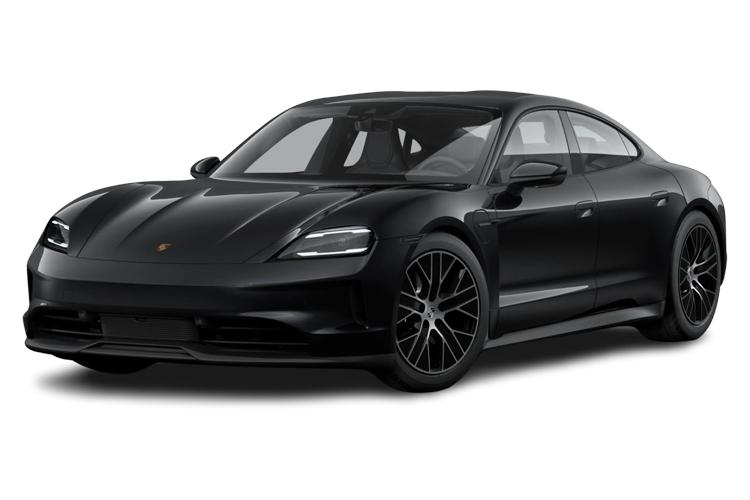
Few engineers ever get to work on a project quite like that of the Polestar 5. Clean sheet design. Dedicated architecture. Few cost constraints. Innovation encouraged and fundamental. This is the Sino-Scandinavian EV brand's most ambitious car yet. As the name suggests, it's the fifth model along in Polestar's development, but in reality it's a replacement for the company's original halo model, the Polestar 1. That car was a big PHEV coupe; this one is an even bigger four-door EV GT but the two cars share the same target market and were designed by the same stylist, former Polestar CEO Thomas Ingenlath. Ingenlath oversaw much of this 5 model's troubled and over-lengthy development, following its origins way back in 2019 as a styling concept named the Precept. The project then hit one snag after another, with the battery chemistry changed halfway through the programme (rendering much of the powertrain development useless). Then, just weeks before the overall design had to be locked in, Ingenlath himself insisted on wheelbase shortening, forcing whole sections of the car into a re-design. Unlike other Polestars, which platform-share with other models overseen by parent company Geely, the 5 gets its own unique platform, a super-stiff bonded extruded aluminium chassis. It's a sort of thing we've seen on hand-built sports cars over the years, most notably Lotus models. Since Lotus is also part of the Geely Group and sells a direct luxury GT four-door competitor to the Polestar 5, the Emeya, you'd think the two brands would have collaborated. Instead, Polestar went its own way, creating bespoke underpinnings that (for the time being) will only be shared with their forthcoming Polestar 6 luxury roadster EV. The core target market here is the Porsche Taycan and its clone, the Audi e-tron GT - in a segment at around the £100,000 price point which has lately shrunk alarmingly. Can Polestar really make this product work?
What kind of driving experience could a car like this offer if you engineered it from a completely clean sheet with nothing borrowed from anything else? Only the Polestar 5 can claim such a CV in this class, with a totally bespoke bonded extruded aluminium chassis (the Polestar Performance Architecture) developed in the UK by team of mainly British engineers experienced in creating generations of English sports cars. From launch, the choice was between two flavours of twin motor (so AWD) EV drivetrain (with a single motor variant planned for the future). Only the rear motor is Polestar-developed (the rear motor is from ZF) and everything is energised by a big 112kWh battery. The base Dual Motor version is all you really need, with 737bhp. Which is 147bhp up on a rival Porsche Taycan S, though the 3.9s 0-62mph time is much the same. Range is 416 miles, 16 up on the Porsche. Most '5' customers though, will probably find the extra for the top Performance model, which offers a huge 871bhp. That's the same as a Taycan Turbo, but the 3.2s 0-62mph time is half a second down on that Porsche and the EV range figure of 351 miles is 40 miles less. In terms of drive dynamics, the unique engineering of this Polestar ought to compensate for any statistical deficits, but at first glance at the spec sheet, you might start to wonder about that. Few of the technical toys you might expect from a six-figure sports GT seem to be present. There's no rear-wheel steering, torque vectoring or limited-slip differential. The Taycan's clever two-speed transmission isn't replicated. There's no air suspension (the bags for it would have ruined the low front bonnet line) and you only get adaptive damping (the magnetorheological kind) if you opt for the top Performance model. From then on though, things get better. You sit low on the lovely Recaro-designed seats and the uniquely developed rear view mirror screen allows you to quickly forget about the lack of a rear window. Expect the exceptional rigidity of that bespoke chassis design to deliver class leading handling, aided by sharp steering and bespoke Michelin Pilot Sport tyres. The result is perhaps the car maybe you'd hoped a Lotus Emeya would be. Perhaps with the Lotus-like underpinnings here, that's appropriate.
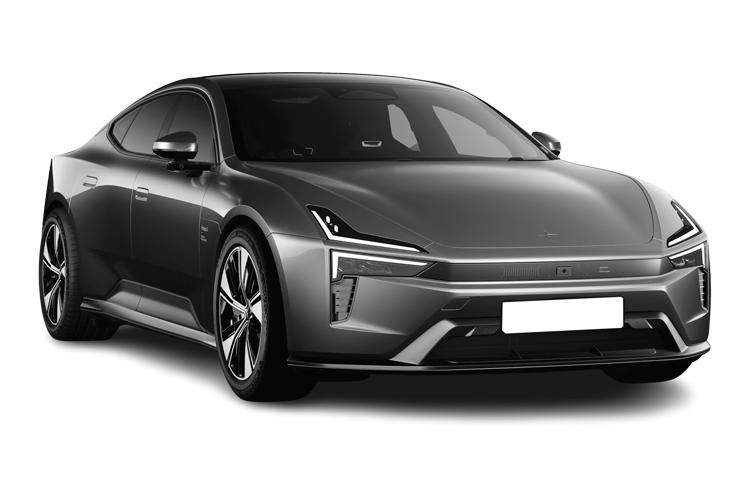
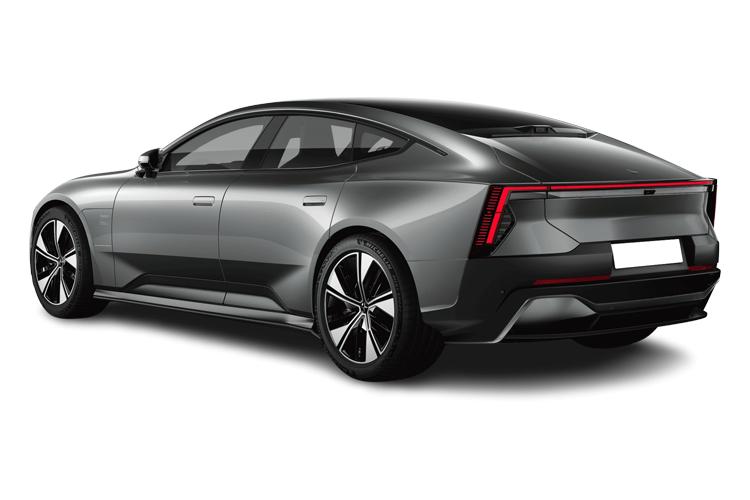
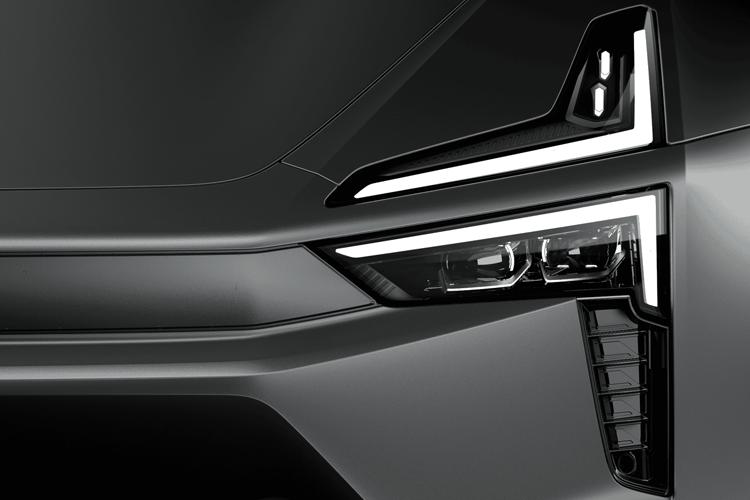
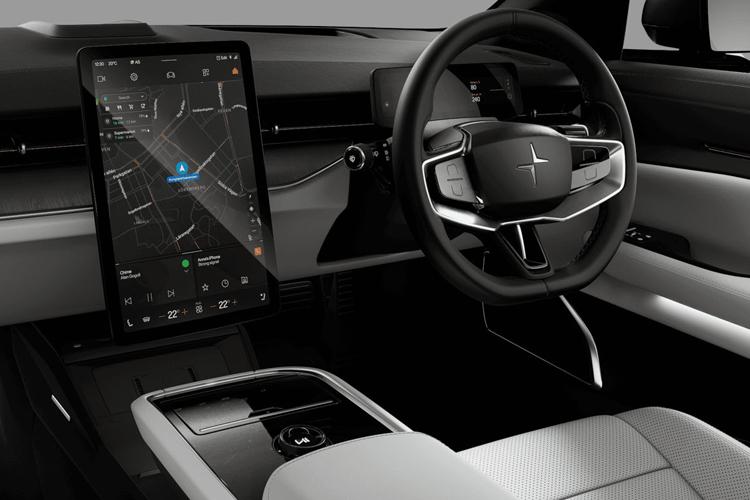
Nothing quite prepares you for the way this car looks, angular and super-low-set thanks to its lightweight rigid Polestar Performance Architecture platform. Like the Polestar 4, there's no rear window - which is becoming a brand trademark. And the flared wheelarches house huge 21 or 22-inch alloy rims. At 5,087mm in length, the 5's sleek silhouette (0.24Cd) is 134mm longer than a Porsche Taycan but 52mm shorter than a Lotus Emeya. The 'Dual Blade' LED headlamps are a little different to the brand's usual 'Thor's Hammer' design. Rivals to this car are almost all SUVs re-packaged as saloons. This one was designed from the start to be a four-door GT and nothing else, which you'll realise when sliding into the properly low-set driving position. It's a lighter, more distinctive and in many ways more exquisitely-finished cabin than you'll find elsewhere in the segment, but it might be a disappointment to find that so much of it has been borrowed from the Polestar 3. Not having a rear window is something that will initially seem strange, but thanks to the full-length glass roof, the interior still feels airy and the digital rear view mirror has special tech so your eyes adjust to it like a normal mirror. The 14.5-inch portrait-format central touchscreen and the 9.0-inch driver's instrument display (with its associated 9.5-inch head-up display) are stock Polestar items, but you don't notice that too much because the finishing is so bespoke, with light wood, a fabric-covered dash top, 35% recycled aluminium inserts and real leather upholstery from high welfare sources. In the back, as in the Polestar 4, you get the benefit of rear window removal in that it enables the rear header rail to be moved further back and the result is an area of the car that feels far more spacious than in a Taycan or an Emeya. There's more legroom too. With the Taycan, Porsche showed that extra foot space could be created via 'foot locker' cut-outs in the underfloor battery. Here, Polestar has gone further by making that cut-out run the entire width of the car. So in theory, you could put someone in the middle, though they wouldn't be very comfortable. The front seat backs are made of impregnated flax. Boot space is rated at 365-litres - and you can fill it completely as there's no rear window to block. You don't have to clutter it up with the charging leads as they can sit in a 62-litre under-bonnet 'frunk' compartment.
From launch, Polestar 5 prices started at £89,500 for the Dual Motor Launch edition variant. The Performance Launch edition model was priced from £104,900. At least you get plenty of standard equipment for that, much of which we've already mentioned in our design section. The Dual Motor version has 20-inch wheels with four-piston Brembo brakes featuring an anodised finish. The Performance model gets larger 22-inch wheels with gold calipers. Audio is taken care of either by the Polestar High Performance Audio system with 10 speakers or the Bowers & Wilkins 21-speaker audio system with Tweeter-on-Top technology and 1,680-watt power output. Laser-line ambient lighting wraps around the cabin, finishing in a sound bar behind the rear occupants' heads, and combined with Active Road Noise Cancellation makes for a luxurious cabin experience. The Polestar 5 Performance uses BWI MagneRide adaptive damping. With this, the dampers read the road up to 1,000 times per second and can react within three milliseconds thanks to magnetorheological fluid, providing excellent body motion control while maintaining comfort and an optimal response at all speeds. Of course the car is festooned with ADAS features. There are 11 vision cameras, one driver monitoring camera, one mid-range radar and 12 ultrasonic sensors.
You'd expect that one of the advantages of a bonded extruded aluminium chassis would be light weight. So it's a surprise to find that this Polestar weighs a substantial 250kg more than the more conventionally-structured rival Porsche Taycan. Which explains the Performance model's 40 mile EV range deficit to its Taycan Turbo competitor. Engineering tweaks have minimised the extent of this deficit. For instance, there's a disconnect clutch so that the 5 can ease along just front-driven at low highway speeds to save energy. There are various selectable regenerative braking strengths to maximise range. And the efficiency figures are quoted at 3.4mpkWh for the Dual Motor and 3.0mpkWh for the Performance. Like the Taycan, there's an 800V electrical architecture that in this case allows DC charging at up to 350kW. That's faster than the Porsche, but for some reason, the 112kWh battery (106kWh usable) 10 to 80% DC charging time of 22 minutes is slightly slower (by four minutes). Full AC charging via a single-phase 7.4kW wallbox takes 15 hours. An external charging indicator on the C-pillar gives a first glance indication of the vehicle's state of charge. At the time of this review, there were 93 Polestar service points in the UK. The brand provides a disappointingly mediocre three year / 60,000 mile warranty and the usual 8-year / 100,000 mile battery warranty to 70% of battery capacity. Plus a 12-year anti-corrosion warranty. There's 3 years of 24/7 roadside assistance.
Polestar is a brand currently reinventing itself. But it must do so while continuing to work with elements of someone else's vision - that of former CEO Thomas Ingenlath. Some parts of his original strategy - like that of only selling online - have proved relatively straightforward for the new management to change. Others - like creating vastly expensive halo models selling in tiny numbers, first the Polestar 1, now this Polestar 5, the current board is stuck with. So resources that could have been used for potentially profitable volume production projects like for, say, a proper SUV or an earlier Polestar 2 replacement, went to this exclusive luxury GT instead. But hey what a car we've ended up with. It's better value and much more unique than its Porsche Taycan arch-rival. Which it'll need to be to find owners in its shrinking segment. And much of it was developed with UK expertise. The EV range isn't exceptional. And perhaps the cabin could do with fewer carry-over parts. But overall, the Polestar 5 feels a really unique product, a worthy successor to its Polestar 1 predecessor. It shouldn't really exist. But I'm glad that it does.
Data provided by CAP-HPI database - Ref# 108237
The Polestar 5 is perhaps the most unique luxury sporting EV we've seen yet. Jonathan Crouch takes a look.
Could this be, for the time being anyway, be the ultimate all-electric luxury car? The Polestar 5 sets out to re-imagine what a high performance Grand Touring four-seat sporting EV can be - and does so in a more bespoke, exclusive, driver-focused way than any of its rivals.
Few engineers ever get to work on a project quite like that of the Polestar 5. Clean sheet design. Dedicated architecture. Few cost constraints. Innovation encouraged and fundamental. This is the Sino-Scandinavian EV brand's most ambitious car yet. As the name suggests, it's the fifth model along in Polestar's development, but in reality it's a replacement for the company's original halo model, the Polestar 1. That car was a big PHEV coupe; this one is an even bigger four-door EV GT but the two cars share the same target market and were designed by the same stylist, former Polestar CEO Thomas Ingenlath. Ingenlath oversaw much of this 5 model's troubled and over-lengthy development, following its origins way back in 2019 as a styling concept named the Precept. The project then hit one snag after another, with the battery chemistry changed halfway through the programme (rendering much of the powertrain development useless). Then, just weeks before the overall design had to be locked in, Ingenlath himself insisted on wheelbase shortening, forcing whole sections of the car into a re-design. Unlike other Polestars, which platform-share with other models overseen by parent company Geely, the 5 gets its own unique platform, a super-stiff bonded extruded aluminium chassis. It's a sort of thing we've seen on hand-built sports cars over the years, most notably Lotus models. Since Lotus is also part of the Geely Group and sells a direct luxury GT four-door competitor to the Polestar 5, the Emeya, you'd think the two brands would have collaborated. Instead, Polestar went its own way, creating bespoke underpinnings that (for the time being) will only be shared with their forthcoming Polestar 6 luxury roadster EV. The core target market here is the Porsche Taycan and its clone, the Audi e-tron GT - in a segment at around the £100,000 price point which has lately shrunk alarmingly. Can Polestar really make this product work?
What kind of driving experience could a car like this offer if you engineered it from a completely clean sheet with nothing borrowed from anything else? Only the Polestar 5 can claim such a CV in this class, with a totally bespoke bonded extruded aluminium chassis (the Polestar Performance Architecture) developed in the UK by team of mainly British engineers experienced in creating generations of English sports cars. From launch, the choice was between two flavours of twin motor (so AWD) EV drivetrain (with a single motor variant planned for the future). Only the rear motor is Polestar-developed (the rear motor is from ZF) and everything is energised by a big 112kWh battery. The base Dual Motor version is all you really need, with 737bhp. Which is 147bhp up on a rival Porsche Taycan S, though the 3.9s 0-62mph time is much the same. Range is 416 miles, 16 up on the Porsche. Most '5' customers though, will probably find the extra for the top Performance model, which offers a huge 871bhp. That's the same as a Taycan Turbo, but the 3.2s 0-62mph time is half a second down on that Porsche and the EV range figure of 351 miles is 40 miles less. In terms of drive dynamics, the unique engineering of this Polestar ought to compensate for any statistical deficits, but at first glance at the spec sheet, you might start to wonder about that. Few of the technical toys you might expect from a six-figure sports GT seem to be present. There's no rear-wheel steering, torque vectoring or limited-slip differential. The Taycan's clever two-speed transmission isn't replicated. There's no air suspension (the bags for it would have ruined the low front bonnet line) and you only get adaptive damping (the magnetorheological kind) if you opt for the top Performance model. From then on though, things get better. You sit low on the lovely Recaro-designed seats and the uniquely developed rear view mirror screen allows you to quickly forget about the lack of a rear window. Expect the exceptional rigidity of that bespoke chassis design to deliver class leading handling, aided by sharp steering and bespoke Michelin Pilot Sport tyres. The result is perhaps the car maybe you'd hoped a Lotus Emeya would be. Perhaps with the Lotus-like underpinnings here, that's appropriate.
Nothing quite prepares you for the way this car looks, angular and super-low-set thanks to its lightweight rigid Polestar Performance Architecture platform. Like the Polestar 4, there's no rear window - which is becoming a brand trademark. And the flared wheelarches house huge 21 or 22-inch alloy rims. At 5,087mm in length, the 5's sleek silhouette (0.24Cd) is 134mm longer than a Porsche Taycan but 52mm shorter than a Lotus Emeya. The 'Dual Blade' LED headlamps are a little different to the brand's usual 'Thor's Hammer' design. Rivals to this car are almost all SUVs re-packaged as saloons. This one was designed from the start to be a four-door GT and nothing else, which you'll realise when sliding into the properly low-set driving position. It's a lighter, more distinctive and in many ways more exquisitely-finished cabin than you'll find elsewhere in the segment, but it might be a disappointment to find that so much of it has been borrowed from the Polestar 3. Not having a rear window is something that will initially seem strange, but thanks to the full-length glass roof, the interior still feels airy and the digital rear view mirror has special tech so your eyes adjust to it like a normal mirror. The 14.5-inch portrait-format central touchscreen and the 9.0-inch driver's instrument display (with its associated 9.5-inch head-up display) are stock Polestar items, but you don't notice that too much because the finishing is so bespoke, with light wood, a fabric-covered dash top, 35% recycled aluminium inserts and real leather upholstery from high welfare sources. In the back, as in the Polestar 4, you get the benefit of rear window removal in that it enables the rear header rail to be moved further back and the result is an area of the car that feels far more spacious than in a Taycan or an Emeya. There's more legroom too. With the Taycan, Porsche showed that extra foot space could be created via 'foot locker' cut-outs in the underfloor battery. Here, Polestar has gone further by making that cut-out run the entire width of the car. So in theory, you could put someone in the middle, though they wouldn't be very comfortable. The front seat backs are made of impregnated flax. Boot space is rated at 365-litres - and you can fill it completely as there's no rear window to block. You don't have to clutter it up with the charging leads as they can sit in a 62-litre under-bonnet 'frunk' compartment.
From launch, Polestar 5 prices started at £89,500 for the Dual Motor Launch edition variant. The Performance Launch edition model was priced from £104,900. At least you get plenty of standard equipment for that, much of which we've already mentioned in our design section. The Dual Motor version has 20-inch wheels with four-piston Brembo brakes featuring an anodised finish. The Performance model gets larger 22-inch wheels with gold calipers. Audio is taken care of either by the Polestar High Performance Audio system with 10 speakers or the Bowers & Wilkins 21-speaker audio system with Tweeter-on-Top technology and 1,680-watt power output. Laser-line ambient lighting wraps around the cabin, finishing in a sound bar behind the rear occupants' heads, and combined with Active Road Noise Cancellation makes for a luxurious cabin experience. The Polestar 5 Performance uses BWI MagneRide adaptive damping. With this, the dampers read the road up to 1,000 times per second and can react within three milliseconds thanks to magnetorheological fluid, providing excellent body motion control while maintaining comfort and an optimal response at all speeds. Of course the car is festooned with ADAS features. There are 11 vision cameras, one driver monitoring camera, one mid-range radar and 12 ultrasonic sensors.
You'd expect that one of the advantages of a bonded extruded aluminium chassis would be light weight. So it's a surprise to find that this Polestar weighs a substantial 250kg more than the more conventionally-structured rival Porsche Taycan. Which explains the Performance model's 40 mile EV range deficit to its Taycan Turbo competitor. Engineering tweaks have minimised the extent of this deficit. For instance, there's a disconnect clutch so that the 5 can ease along just front-driven at low highway speeds to save energy. There are various selectable regenerative braking strengths to maximise range. And the efficiency figures are quoted at 3.4mpkWh for the Dual Motor and 3.0mpkWh for the Performance. Like the Taycan, there's an 800V electrical architecture that in this case allows DC charging at up to 350kW. That's faster than the Porsche, but for some reason, the 112kWh battery (106kWh usable) 10 to 80% DC charging time of 22 minutes is slightly slower (by four minutes). Full AC charging via a single-phase 7.4kW wallbox takes 15 hours. An external charging indicator on the C-pillar gives a first glance indication of the vehicle's state of charge. At the time of this review, there were 93 Polestar service points in the UK. The brand provides a disappointingly mediocre three year / 60,000 mile warranty and the usual 8-year / 100,000 mile battery warranty to 70% of battery capacity. Plus a 12-year anti-corrosion warranty. There's 3 years of 24/7 roadside assistance.
Polestar is a brand currently reinventing itself. But it must do so while continuing to work with elements of someone else's vision - that of former CEO Thomas Ingenlath. Some parts of his original strategy - like that of only selling online - have proved relatively straightforward for the new management to change. Others - like creating vastly expensive halo models selling in tiny numbers, first the Polestar 1, now this Polestar 5, the current board is stuck with. So resources that could have been used for potentially profitable volume production projects like for, say, a proper SUV or an earlier Polestar 2 replacement, went to this exclusive luxury GT instead. But hey what a car we've ended up with. It's better value and much more unique than its Porsche Taycan arch-rival. Which it'll need to be to find owners in its shrinking segment. And much of it was developed with UK expertise. The EV range isn't exceptional. And perhaps the cabin could do with fewer carry-over parts. But overall, the Polestar 5 feels a really unique product, a worthy successor to its Polestar 1 predecessor. It shouldn't really exist. But I'm glad that it does.
MERCEDES-BENZ C CLASS ELECTRIC
C 400 4MATIC 360kW Sport 94kWh 5dr Auto

POA
POA