
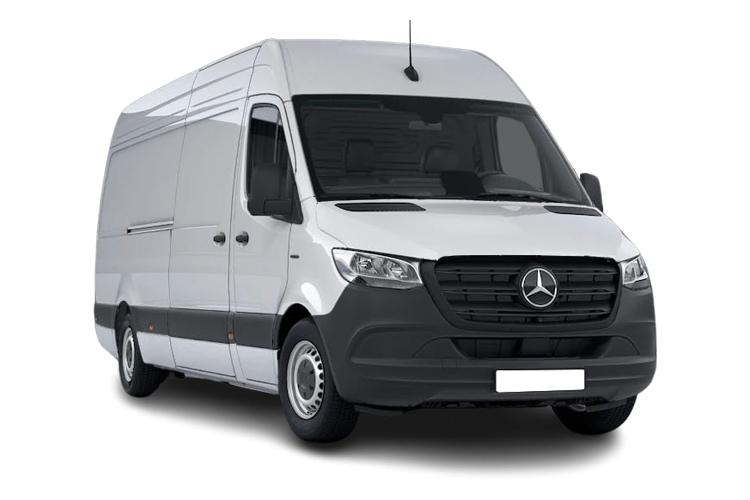
Images are for illustrative purposes only.
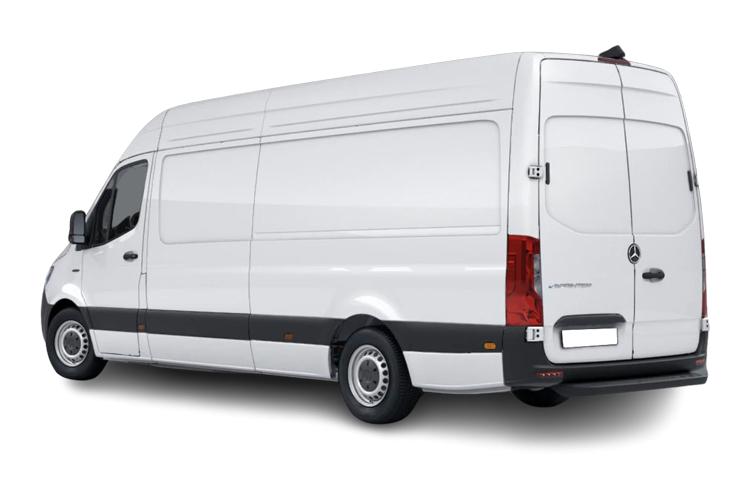

150kW 81kWh Pro Van Auto
Need some assistance or advice? Call Us 01903 538835


Mercedes has redefined state-of-the-art technology in the sector for large full-electric vans with this revitalised eSprinter. Jonathan Crouch drives it.
Mercedes has invested around 350 million euros into fundamentally improving its largest EV van, the eSprinter. Though the design changes are slight, the engineering updates are far-reaching, including a switch to rear wheel drive and a new range of batteries, the largest of which can take this LCV nearly three times as far as the original. In one giant leap, the Three-Pointed Star is back amongst the class leaders for large EV vans. Whether you could justify the cost of one is another question.
Manufacturers of large electric vans in Europe are in a quandary. They've been mandated under Euro 7 regulations to switch to full-electric drivetrains. But demand is way behind the aspirations of the politicians and it's clear that alongside EV-powered vans, they will also have to be producing diesel-powered ones for some time yet. With the eSprinter, their largest electric van, Mercedes' response to this has been in two parts. The original model, launched in 2020 with a feeble 95 mile range from its 55kWh battery and limited body options, clearly wasn't cutting it. Hence the far-reaching update we look at here, providing a top 113kWh battery that'll nearly treble that original model's driving range. Everything's changed here: in fact, Mercedes claims the only carry-over component from the original eSprinter is the charging port on the grille. And everything will change again from 2025 onwards when an all-new generation of Sprinter arrives based on the brand's van.ea architecture. That's for the future, but let's look at what this far-reaching first eSprinter update means for right now.
Engineering changes don't get much more fundamental than this. The eSprinter has switched from front to rear wheel drive, with the drivetrain now part of a new modular set-up. At the back, there's a completely new rear axle containing an electric motor putting out either 136PS or 204PS, depending on your preference. The vehicle's high voltage components and control systems now lie in the front portion of this van. While the battery packs sit in the middle under the floor and are now made of lithium-ion-phosphate and contain no nickel or cobalt. In place of the original model's old-tech 55kWh pack, there's now a choice of two available batteries: an entry-level 81kWh option and the top 113kWh battery that can take this Mercedes as far as 273 miles. Both motors put out a gutsy 400Nm of torque, one reason why the eSprinter can pull a 2,000kg trailer. And each motor weighs only around 130kgs and is characterised by particularly high efficiency and optimised thermal management. Three driving programmes: Maximum Range, Eco and Comfort, control engine power, engine torque and climate control. You won't want to be selecting Maximum Range too often because it reduces power by 20%. There's a regenerative braking system of course, to convert kinetic energy into electrical energy, which is controlled via these wheel-mounted paddle selectors; choose between five levels, the fiercest is 'D-', though you'll probably just leave your eSprinter in 'D Auto', which uses a radar sensor to select the optimum amount of regen, based on traffic or topography. Handling through the turns is actually slightly better than the diesel equivalent thanks to all the low-slung batteries. Refinement is un-bettered in the class - up to the highest Mercedes van standards. The turning circle is 13.4-metres with the L2 version and 15.3-metres with this extra-long L3.
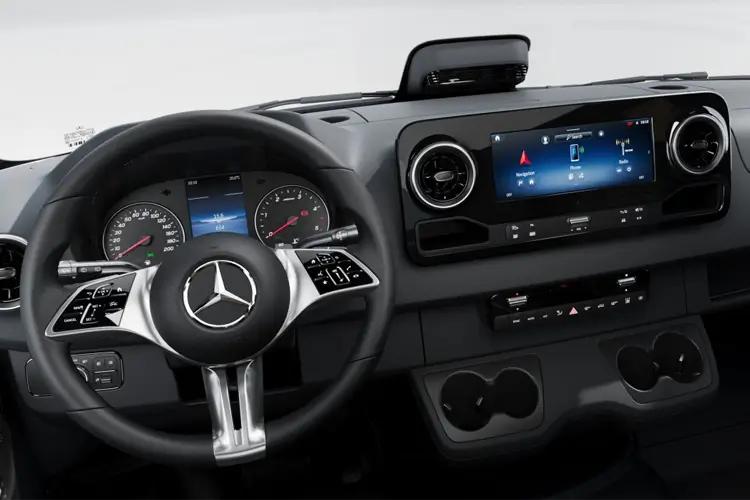
You would never know from a glance at this improved eSprinter just how fundamentally its engineering has changed beneath the panel work. As before, there's a centrally-positioned charging port on the grille, which is actually the only carry-over part from the original model. That original came only in one single body shape, but Mercedes offers a wider range with this enhanced eSprinter, starting with L2 and L3-length models, the latter with load space of up to 14m3. You can also talk to your dealer about chassis cab and factory-made dropside and refrigerated body options. It'll be a little easier to identify this improved eSprinter from inside the cab because there's quite a lot more technology included. Primarily the latest version of Mercedes' MBUX infotainment system, which incorporates a 10.25-inch centre screen and 'Hey Mercedes' virtual assistant voice control. The MBUX setup was missing from the original eSprinter. Otherwise, things are much like they would be with the diesel Sprinter. So the driver's workplace is uncluttered and practical, with ergonomically-shaped seats, plus a variable stowage concept ensures that everything has its place. The interior also features a modular dashboard design that allows for maximum flexibility - everything from extra storage, to cutting-edge infotainment and wireless charging is available. For pleasant temperatures inside the cockpit, owners can choose between a semi-automatic air conditioning system or automatic climate control, according to their comfort requirements.
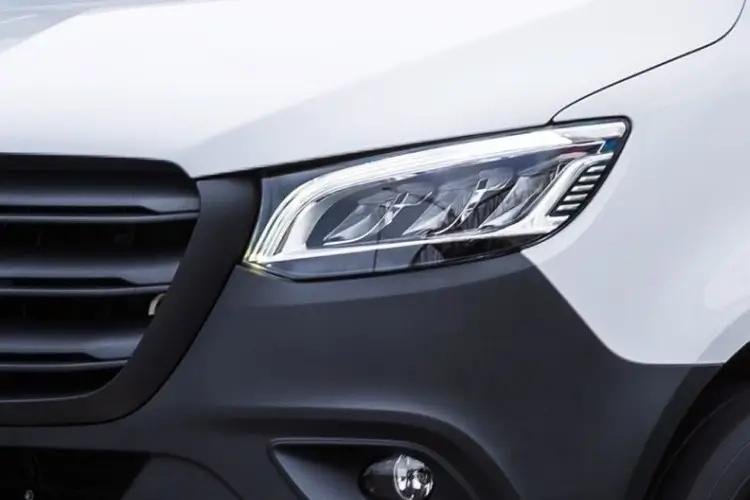
So it's fairly straightforward; two power levels (136PS or 204PS); two high-voltage battery versions (81kWh or 113kWh); two length variants L2 (long) or L3 (extra-long); and two available trim levels ('PRO' or 'SELECT'). There are three Gross Vehicle Weight options for the 81kWh version - 2,500, 4150 or 4250kgs; for this 113kWh model, it's only 4,250kgs. There's just a single roof height. If you don't want the panel van, you can also talk to your dealer about chassis cab and factory-made dropside and refrigerated body options. As we compiled this Review in Autumn 2024, eSprinter pricing started from around £60,000 ex-VAT, but you can add a further £17,000 to that figure for a top variant like the one we tried, which was a '420' L3 van with the 204PS motor, the bigger 113kWh battery and plusher 'SELECT' trim. Remember that you can still take £5,000 from the asking price courtesy of the government's OLEZ grant (or at least you could at the time of our test). Plus eligible businesses could enjoy savings of up to £9,500 thanks to the TFL scrappage scheme. You do at least get plenty of equipment for that. Base 'PRO' spec comes with double wing doors opening to the side walls, wood flooring, TEMPMATIC air conditioning with pre-entry climate control, a heated driver's seat with armrest, a reversing camera, an intelligent tachograph, an 8-metre Mode 3 charging cable and the MBUX multimedia system with its 10.25-inch centre screen, voice assistant, over-the-air updates and 'Apple CarPlay'/'Android Auto' smartphone-mirroring. This 'SELECT' version adds LED High Performance headlamps with High Beam Assist, a more supportive 'Comfort' spec driver's seat with lumbar support, a leather-stitched steering wheel, front and rear mudflaps and a 'charging package' for the dashboard.
This revitalised model can now be had, as we've said elsewhere in this Review, in both L2 and L3 forms. The L2 offers 9m3 of capacity, with 3,375mm of load length. This L3 version offers 14m3 of capacity, with 4,410mm of load length. Both versions have 1,350mm of loading width between the wheelarches and 2,009mm of load area height. As usual with an EV van, the electric powertrain doesn't compromise the loading area in any way. The Gross Vehicle Weight with the largest 850kg 113kWh battery pack tops out at 4.25 tonnes. Where you usually lose out with an EV van though, is in terms of payload - and so it is here. Mercedes quotes a maximum eSprinter payload of up to 1,250kgs, but that only applies to the weightiest 81kWh variants - and doesn't apply to the 113kWh battery model we tried, which in the form tested has a payload of 920kg. A base 81kWh eSprinter could have a payload of as little as 414kgs; this is where you really lose out to a diesel-engined model. The eSprinter can now DC charge at up to 115KW via its CCS Type 2 radiator grille socket - which is the same as Ford's E-Transit but some way below the 150kW figure you now get from Stellantis Group large van EV rivals from Fiat, Vauxhall, Citroen and Peugeot. This means that replenishing the eSprinter's entry-level 81kWh battery from 10 to 80% can be done in 32 minutes from a powerful DC rapid public charging point; allow 42 minutes for the largest-capacity 113kWh battery. This improved eSprinter can also charge at up to 11kW from an AC wall box or public charger. A full AC wallbox 11kW charge would take 8 hours with the 81kWh model or 11 hours with this 113kWh variant. Charging on a single-phase supply from a 7.4kW wallbox would take up to 17 hours.
That the first generation eSprinter was something of a bodge job doesn't matter much. Most of the market wasn't quite ready for it anyway. What's important is that Mercedes has a large electric van worthy of its brand for the present and the future - and this revitalised eSprinter seems to be exactly that. We're surprised the company didn't wait until its next-generation van.ea-platform MK4 Sprinter model to move things along, but the marque's hand was clearly forced by the excellence of the Ford E-Transit, launched in 2022. So it is that this MK3-era Sprinter will actually end its life cycle with an electric version worthy of the technological heritage that lies behind the Three-Pointed Star on its bonnet. This may look the same as the original eSprinter, but just about everything is actually different - and certainly better. The modular design means that Mercedes can more easily produce it alongside diesel models. And customers will appreciate the fact that there's a much bigger body shape option than before. This revitalised eSprinter though, will have a rather premium price, particularly in its largest-battery form. Which could keep the much more affordable rival Ford E-Transit in the frame for quite a few company customers. Make no mistake though; beyond these two models, choosing any of the other large EV-powered vans in this segment is simply opting for yesterday's technology.
Data provided by CAP-HPI database - Ref# 61111
Mercedes has redefined state-of-the-art technology in the sector for large full-electric vans with this revitalised eSprinter. Jonathan Crouch drives it.
Mercedes has invested around 350 million euros into fundamentally improving its largest EV van, the eSprinter. Though the design changes are slight, the engineering updates are far-reaching, including a switch to rear wheel drive and a new range of batteries, the largest of which can take this LCV nearly three times as far as the original. In one giant leap, the Three-Pointed Star is back amongst the class leaders for large EV vans. Whether you could justify the cost of one is another question.
Manufacturers of large electric vans in Europe are in a quandary. They've been mandated under Euro 7 regulations to switch to full-electric drivetrains. But demand is way behind the aspirations of the politicians and it's clear that alongside EV-powered vans, they will also have to be producing diesel-powered ones for some time yet. With the eSprinter, their largest electric van, Mercedes' response to this has been in two parts. The original model, launched in 2020 with a feeble 95 mile range from its 55kWh battery and limited body options, clearly wasn't cutting it. Hence the far-reaching update we look at here, providing a top 113kWh battery that'll nearly treble that original model's driving range. Everything's changed here: in fact, Mercedes claims the only carry-over component from the original eSprinter is the charging port on the grille. And everything will change again from 2025 onwards when an all-new generation of Sprinter arrives based on the brand's van.ea architecture. That's for the future, but let's look at what this far-reaching first eSprinter update means for right now.
Engineering changes don't get much more fundamental than this. The eSprinter has switched from front to rear wheel drive, with the drivetrain now part of a new modular set-up. At the back, there's a completely new rear axle containing an electric motor putting out either 136PS or 204PS, depending on your preference. The vehicle's high voltage components and control systems now lie in the front portion of this van. While the battery packs sit in the middle under the floor and are now made of lithium-ion-phosphate and contain no nickel or cobalt. In place of the original model's old-tech 55kWh pack, there's now a choice of two available batteries: an entry-level 81kWh option and the top 113kWh battery that can take this Mercedes as far as 273 miles. Both motors put out a gutsy 400Nm of torque, one reason why the eSprinter can pull a 2,000kg trailer. And each motor weighs only around 130kgs and is characterised by particularly high efficiency and optimised thermal management. Three driving programmes: Maximum Range, Eco and Comfort, control engine power, engine torque and climate control. You won't want to be selecting Maximum Range too often because it reduces power by 20%. There's a regenerative braking system of course, to convert kinetic energy into electrical energy, which is controlled via these wheel-mounted paddle selectors; choose between five levels, the fiercest is 'D-', though you'll probably just leave your eSprinter in 'D Auto', which uses a radar sensor to select the optimum amount of regen, based on traffic or topography. Handling through the turns is actually slightly better than the diesel equivalent thanks to all the low-slung batteries. Refinement is un-bettered in the class - up to the highest Mercedes van standards. The turning circle is 13.4-metres with the L2 version and 15.3-metres with this extra-long L3.
You would never know from a glance at this improved eSprinter just how fundamentally its engineering has changed beneath the panel work. As before, there's a centrally-positioned charging port on the grille, which is actually the only carry-over part from the original model. That original came only in one single body shape, but Mercedes offers a wider range with this enhanced eSprinter, starting with L2 and L3-length models, the latter with load space of up to 14m3. You can also talk to your dealer about chassis cab and factory-made dropside and refrigerated body options. It'll be a little easier to identify this improved eSprinter from inside the cab because there's quite a lot more technology included. Primarily the latest version of Mercedes' MBUX infotainment system, which incorporates a 10.25-inch centre screen and 'Hey Mercedes' virtual assistant voice control. The MBUX setup was missing from the original eSprinter. Otherwise, things are much like they would be with the diesel Sprinter. So the driver's workplace is uncluttered and practical, with ergonomically-shaped seats, plus a variable stowage concept ensures that everything has its place. The interior also features a modular dashboard design that allows for maximum flexibility - everything from extra storage, to cutting-edge infotainment and wireless charging is available. For pleasant temperatures inside the cockpit, owners can choose between a semi-automatic air conditioning system or automatic climate control, according to their comfort requirements.
So it's fairly straightforward; two power levels (136PS or 204PS); two high-voltage battery versions (81kWh or 113kWh); two length variants L2 (long) or L3 (extra-long); and two available trim levels ('PRO' or 'SELECT'). There are three Gross Vehicle Weight options for the 81kWh version - 2,500, 4150 or 4250kgs; for this 113kWh model, it's only 4,250kgs. There's just a single roof height. If you don't want the panel van, you can also talk to your dealer about chassis cab and factory-made dropside and refrigerated body options. As we compiled this Review in Autumn 2024, eSprinter pricing started from around £60,000 ex-VAT, but you can add a further £17,000 to that figure for a top variant like the one we tried, which was a '420' L3 van with the 204PS motor, the bigger 113kWh battery and plusher 'SELECT' trim. Remember that you can still take £5,000 from the asking price courtesy of the government's OLEZ grant (or at least you could at the time of our test). Plus eligible businesses could enjoy savings of up to £9,500 thanks to the TFL scrappage scheme. You do at least get plenty of equipment for that. Base 'PRO' spec comes with double wing doors opening to the side walls, wood flooring, TEMPMATIC air conditioning with pre-entry climate control, a heated driver's seat with armrest, a reversing camera, an intelligent tachograph, an 8-metre Mode 3 charging cable and the MBUX multimedia system with its 10.25-inch centre screen, voice assistant, over-the-air updates and 'Apple CarPlay'/'Android Auto' smartphone-mirroring. This 'SELECT' version adds LED High Performance headlamps with High Beam Assist, a more supportive 'Comfort' spec driver's seat with lumbar support, a leather-stitched steering wheel, front and rear mudflaps and a 'charging package' for the dashboard.
This revitalised model can now be had, as we've said elsewhere in this Review, in both L2 and L3 forms. The L2 offers 9m3 of capacity, with 3,375mm of load length. This L3 version offers 14m3 of capacity, with 4,410mm of load length. Both versions have 1,350mm of loading width between the wheelarches and 2,009mm of load area height. As usual with an EV van, the electric powertrain doesn't compromise the loading area in any way. The Gross Vehicle Weight with the largest 850kg 113kWh battery pack tops out at 4.25 tonnes. Where you usually lose out with an EV van though, is in terms of payload - and so it is here. Mercedes quotes a maximum eSprinter payload of up to 1,250kgs, but that only applies to the weightiest 81kWh variants - and doesn't apply to the 113kWh battery model we tried, which in the form tested has a payload of 920kg. A base 81kWh eSprinter could have a payload of as little as 414kgs; this is where you really lose out to a diesel-engined model. The eSprinter can now DC charge at up to 115KW via its CCS Type 2 radiator grille socket - which is the same as Ford's E-Transit but some way below the 150kW figure you now get from Stellantis Group large van EV rivals from Fiat, Vauxhall, Citroen and Peugeot. This means that replenishing the eSprinter's entry-level 81kWh battery from 10 to 80% can be done in 32 minutes from a powerful DC rapid public charging point; allow 42 minutes for the largest-capacity 113kWh battery. This improved eSprinter can also charge at up to 11kW from an AC wall box or public charger. A full AC wallbox 11kW charge would take 8 hours with the 81kWh model or 11 hours with this 113kWh variant. Charging on a single-phase supply from a 7.4kW wallbox would take up to 17 hours.
That the first generation eSprinter was something of a bodge job doesn't matter much. Most of the market wasn't quite ready for it anyway. What's important is that Mercedes has a large electric van worthy of its brand for the present and the future - and this revitalised eSprinter seems to be exactly that. We're surprised the company didn't wait until its next-generation van.ea-platform MK4 Sprinter model to move things along, but the marque's hand was clearly forced by the excellence of the Ford E-Transit, launched in 2022. So it is that this MK3-era Sprinter will actually end its life cycle with an electric version worthy of the technological heritage that lies behind the Three-Pointed Star on its bonnet. This may look the same as the original eSprinter, but just about everything is actually different - and certainly better. The modular design means that Mercedes can more easily produce it alongside diesel models. And customers will appreciate the fact that there's a much bigger body shape option than before. This revitalised eSprinter though, will have a rather premium price, particularly in its largest-battery form. Which could keep the much more affordable rival Ford E-Transit in the frame for quite a few company customers. Make no mistake though; beyond these two models, choosing any of the other large EV-powered vans in this segment is simply opting for yesterday's technology.
