
Images are for illustrative purposes only.

95kW 40kWh H2 Acenta Van Auto
Need some assistance or advice? Call Us 01903 538835


The Interstar, Nissan's biggest van, now comes as an EV. Jonathan Crouch drives the Interstar-e.
Nissan's largest van, the re-invented Interstar, looks a strong prospect in this full-electric Interstar-e form. It has a sharp look, a smartly designed cabin and an impressive level of media connectivity and drive assist features.
The last part of the LCV market likely to go full-electric is that for really large vans. But that day will come a lot sooner once the products available improve - which is happening bit by bit, as evidenced by the model we look at here, Nissan's Interstar-e. A bit of background first. Initially, the large segment electric vans that first appeared at the end of the last decade really weren't very good at all. The very first of these was the Renault Master E-Tech, but so poor was that French model's EV driving range that the electric version of its clone, the Nissan Interstar, never appeared. Fast forward to 2024 though and things were very different. The electric version of the new generation Renault Master was a vastly more competitive proposition and Nissan has embraced it wholeheartedly to create the model we look at here, the Interstar-e. Let's take a closer look.
From launch here, this EV variant was offered with the option of a smaller 40kWh battery, but Nissan's now discontinued that because it turned out that everyone wanted the more usable 87kWh battery we're trying here, which is rated at up to 285 miles between charges and is paired with a 143bhp motor developing 300Nm of pulling power. You'll need to restrain yourself from using all of that torque if you're to get anywhere near the EV mileage figure we just quoted. To manage that, you're also going to have to virtually always engage a provided 'ECO' button on the dashboard (which dampens throttle response considerably); and make sure you always engage the 'B' regenerative drive format via this gearchange stalk behind the wheel. Regen braking in the Insterstar-e works via a clever power-assisted 'one-box' dynamic braking control system that keeps braking effectiveness and pedal feel the same, regardless of how much weight the van is carrying. It also triggers the automatic emergency braking system sooner (response time has been halved over the old model) and enhances the harvesting of regenerative energy, theoretically extending the range of this electric version. In city streets, we found all-round visibility to be good for a large van of this size. The squared-off front end makes it easy to work out where the extremities lie, helped by a parking sensor system that, interestingly, can be had with three different sound formats - 'Pure', 'Accurate' and 'Expressive'. The shorter wheelbase and redesigned front axle of this second generation design provide for extra manoeuvrability, including a 1.5-metre-shorter turning diameter, now rated at 12.8-metres for the L2 and 14.6-metres for this L3 version.
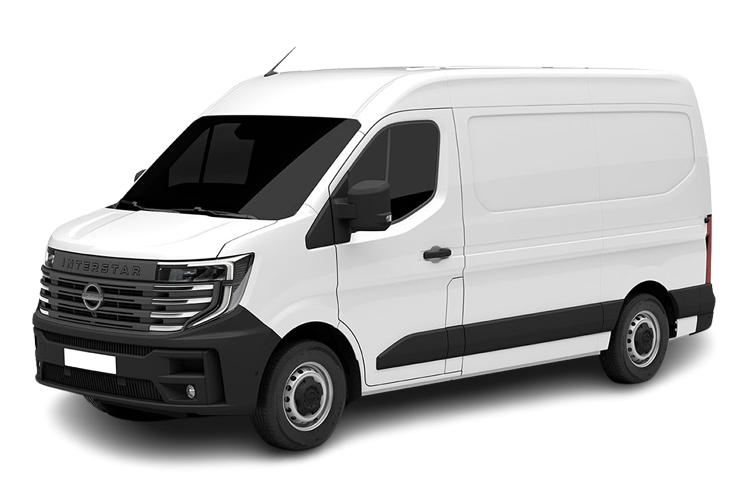
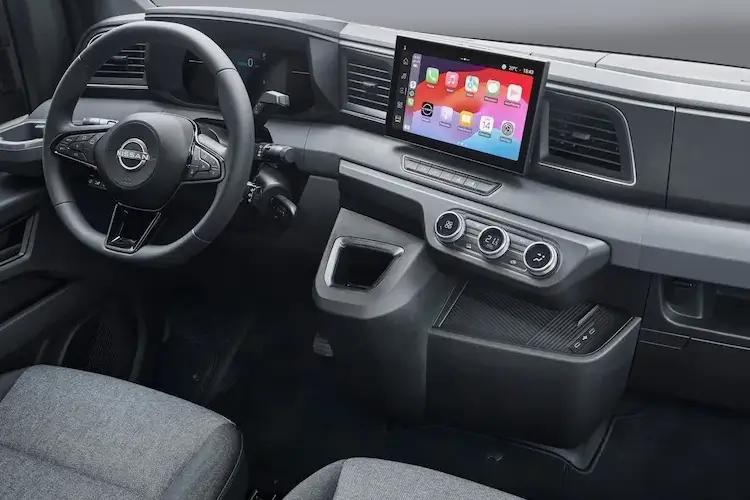
Nissan, who crafted the look of this new generation Interstar at its design centre in London, says it was going for exterior styling 'that exudes the feeling of a full-sized truck'. You're going to have to like that; the assertive front grille certainly gives this van a commanding look, with square lamp units and the Interstar name across the nose. The boxy grille incorporates sharp LED daytime running lights, plus aerodynamics have been optimised with a raked windscreen and a flat floor. The result is a relatively sleek Cd factor. Inside, thankfully it doesn't feel much like a truck, though the steering wheel is more vertical than before. The sculpted dashboard features a 10.1-inch touchscreen angled towards the driver to make it easier to read and use. There are two large cup holders, large overhead shelves, ten open storage areas, plus another three closed areas that together offer nearly 80-litres of stowage space, including a multi-purpose central seatback workspace unit and a large under-seat storage box. Around 135-litres of cubby space is available around the interior. There's the usual three-seat cabin bench, with harder-wearing upholstery and the option of heated seats. With the bench format, the back of the middle seat folds down into a desk, while the base houses a slot to store a laptop and there are USB-C ports to power devices. With this EV version, you get a 7-inch instrument screen.
Interstar-e asking prices at the time of our test in Autumn 2025 were pitched from around £43,000, from which you can of course deduct the £5,000 Plug-in Van Grant. There are two main Gross Vehicle Weight options - the 3.5-tonne '35' version or the 4.0-tonne '40' variant; and with the panel van, two main body lengths, L2 or L3. There's no high-roof option on the EV. You get a choice between two trim levels - 'Acenta' or 'Tekna'. If you don't want the conventional panel van body shape, Nissan also offers Dropside and Luton van options, along with Chassis and Platform variants for those needing a basis for bespoke conversions. Let's talk about spec. The mainstream 'Acenta' trim level includes most of what you'd need. Specifically a nearside side-loading door, rear parking sensors, powered heated door mirrors, headlamps with auto high & low beam, LED daytime running lights and front fog lamps, a Thatcham alarm, an anti-theft immobiliser, a spare wheel, and cruise control with a variable speed limiter. Inside, there's air conditioning and a six-way-adjustable driver's seat with an arm rest. The Electric models get a 7-inch digital instrument cluster too. Media tech's taken care of by a 10.1-inch centre screen that includes 'Apple CarPlay' and 'Android Auto'. And all Interstars get an LED light for the loading area. The top 'Tekna' trim level, identifiable by the full covers applied to the 16-inch steel wheels, adds a raft of useful upgrades for a price uplift of £1,200 + VAT. These include automatic air conditioning, a heated windscreen, a rear-view camera, front parking sensors and flank protection, 270-degree opening rear doors, a 12V plug in the loading area, an additional 10 anchorage fixing rings on the C & D-pillars, upgraded 'Tekna' upholstery and lumbar adjustment on the driver seat.
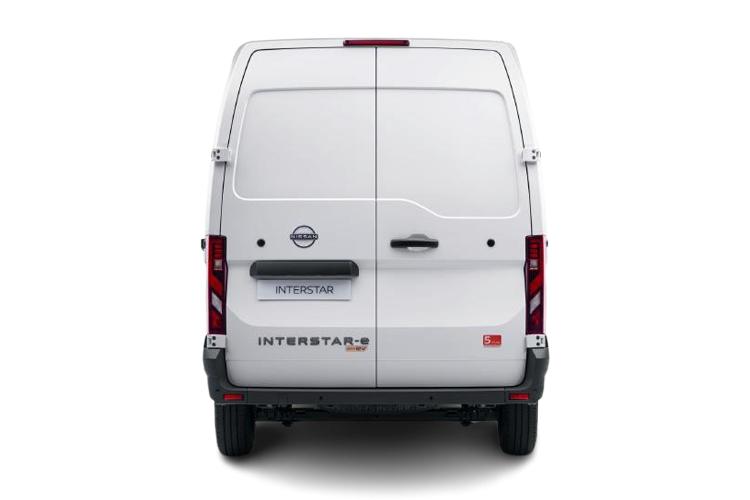
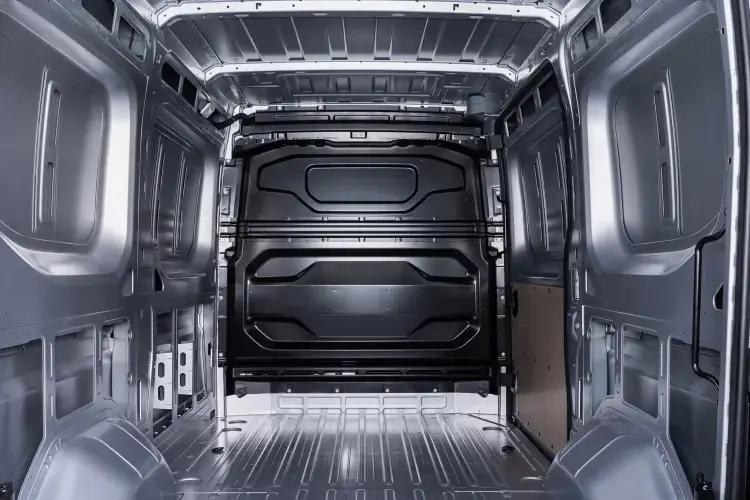
The big news with this second generation Interstar design is the optimised aerodynamics, which not only improves efficiency but also allows this Nissan to allocate more of its Gross Vehicle Weight to payload. In terms of what this Interstar can carry, that hugely helps the EV version - to the point where it can offer payload figures (between 1,197kg to 1,694kg) that are very little different to those of the diesel version (rated at between 1,175kg to 1,862kg). You're going to want to know about cargo capacity. The base-shape L2H2 variant offers 3,225mm of floor load length, with 1,885mm of load area height and 1,789mm of load area width, narrowing to 1,380mm between the wheel arches, all of which translates into a cargo area volume of 10.8m3. If you need more, the L3H2 offers 3,855mm of load area length, which boosts volume to 13.0m3. Disappointingly, there's no load-through hatch into the cab (even as an option) to increase the loading length for longer items. The sliding side door offers an aperture which has a 40mm wider opening with this MK2 design - now 1,312mm in width, so forklifts are going to be able to get pallets in and out even more easily. There's 1,753mm of side door loading height. As for running costs, well, the Interstar-e electric version's 87kWh battery provides a WLTP range of 285 miles. The centre monitor also has an 'Energy' section with a powerflow meter and menus to set charging times and battery charging limits. On the subject of charging, the Interstar-e will charge at up to 130kW from a DC rapid charger, which means a full charge of this 87kWh model will take 1 hour and 10 minutes - and you can add 112 miles of range in just 19 minutes. What about AC charging? Well if you'll be doing that using a typical 7.4kW single-phase wallbox, a full charge of this 87kWh Interstar-e would take 13 hours and 54 minutes - and you could add 112 miles of range in 5 hours 44 minutes. Pretty much everything we've told you in this section would also apply to this model's Renault Master design clone. What different with this Nissan though, is the warranty that comes with it, a 5 year/100,000 mile package that gives you two years more cover than you'd get with the equivalent Renault.
There have been three distinct phases in recent progress for large-size electric vans. The initial 2019-2021-era models, which are best forgotten. Then there was the Ford E-Transit of 2022, which showed how much better they should have been. Then in 2023, we got a wave of new generation large LCV electric models launched in response to that, one of which was this Interstar-e. If you're a business owner who has previously considered a large electric van but been disappointed and turned back to diesel, consider again because these fresh-era battery-powered models are worth a second look. But why an Interstar-e? Well, a primary draw is a better warranty than you'd get with most of its competitors, including its clone, the Renault Master E-Tech. If your Nissan van dealer can match that with an appealing financial proposition, then you might be tempted because there's not much wrong with the product. Big electric vans will still get better than this, but the greatest forward steps with this technology may already have been made. As this Nissan proves.
Data provided by CAP-HPI database - Ref# 61538
The Interstar, Nissan's biggest van, now comes as an EV. Jonathan Crouch drives the Interstar-e.
Nissan's largest van, the re-invented Interstar, looks a strong prospect in this full-electric Interstar-e form. It has a sharp look, a smartly designed cabin and an impressive level of media connectivity and drive assist features.
The last part of the LCV market likely to go full-electric is that for really large vans. But that day will come a lot sooner once the products available improve - which is happening bit by bit, as evidenced by the model we look at here, Nissan's Interstar-e. A bit of background first. Initially, the large segment electric vans that first appeared at the end of the last decade really weren't very good at all. The very first of these was the Renault Master E-Tech, but so poor was that French model's EV driving range that the electric version of its clone, the Nissan Interstar, never appeared. Fast forward to 2024 though and things were very different. The electric version of the new generation Renault Master was a vastly more competitive proposition and Nissan has embraced it wholeheartedly to create the model we look at here, the Interstar-e. Let's take a closer look.
From launch here, this EV variant was offered with the option of a smaller 40kWh battery, but Nissan's now discontinued that because it turned out that everyone wanted the more usable 87kWh battery we're trying here, which is rated at up to 285 miles between charges and is paired with a 143bhp motor developing 300Nm of pulling power. You'll need to restrain yourself from using all of that torque if you're to get anywhere near the EV mileage figure we just quoted. To manage that, you're also going to have to virtually always engage a provided 'ECO' button on the dashboard (which dampens throttle response considerably); and make sure you always engage the 'B' regenerative drive format via this gearchange stalk behind the wheel. Regen braking in the Insterstar-e works via a clever power-assisted 'one-box' dynamic braking control system that keeps braking effectiveness and pedal feel the same, regardless of how much weight the van is carrying. It also triggers the automatic emergency braking system sooner (response time has been halved over the old model) and enhances the harvesting of regenerative energy, theoretically extending the range of this electric version. In city streets, we found all-round visibility to be good for a large van of this size. The squared-off front end makes it easy to work out where the extremities lie, helped by a parking sensor system that, interestingly, can be had with three different sound formats - 'Pure', 'Accurate' and 'Expressive'. The shorter wheelbase and redesigned front axle of this second generation design provide for extra manoeuvrability, including a 1.5-metre-shorter turning diameter, now rated at 12.8-metres for the L2 and 14.6-metres for this L3 version.
Nissan, who crafted the look of this new generation Interstar at its design centre in London, says it was going for exterior styling 'that exudes the feeling of a full-sized truck'. You're going to have to like that; the assertive front grille certainly gives this van a commanding look, with square lamp units and the Interstar name across the nose. The boxy grille incorporates sharp LED daytime running lights, plus aerodynamics have been optimised with a raked windscreen and a flat floor. The result is a relatively sleek Cd factor. Inside, thankfully it doesn't feel much like a truck, though the steering wheel is more vertical than before. The sculpted dashboard features a 10.1-inch touchscreen angled towards the driver to make it easier to read and use. There are two large cup holders, large overhead shelves, ten open storage areas, plus another three closed areas that together offer nearly 80-litres of stowage space, including a multi-purpose central seatback workspace unit and a large under-seat storage box. Around 135-litres of cubby space is available around the interior. There's the usual three-seat cabin bench, with harder-wearing upholstery and the option of heated seats. With the bench format, the back of the middle seat folds down into a desk, while the base houses a slot to store a laptop and there are USB-C ports to power devices. With this EV version, you get a 7-inch instrument screen.
Interstar-e asking prices at the time of our test in Autumn 2025 were pitched from around £43,000, from which you can of course deduct the £5,000 Plug-in Van Grant. There are two main Gross Vehicle Weight options - the 3.5-tonne '35' version or the 4.0-tonne '40' variant; and with the panel van, two main body lengths, L2 or L3. There's no high-roof option on the EV. You get a choice between two trim levels - 'Acenta' or 'Tekna'. If you don't want the conventional panel van body shape, Nissan also offers Dropside and Luton van options, along with Chassis and Platform variants for those needing a basis for bespoke conversions. Let's talk about spec. The mainstream 'Acenta' trim level includes most of what you'd need. Specifically a nearside side-loading door, rear parking sensors, powered heated door mirrors, headlamps with auto high & low beam, LED daytime running lights and front fog lamps, a Thatcham alarm, an anti-theft immobiliser, a spare wheel, and cruise control with a variable speed limiter. Inside, there's air conditioning and a six-way-adjustable driver's seat with an arm rest. The Electric models get a 7-inch digital instrument cluster too. Media tech's taken care of by a 10.1-inch centre screen that includes 'Apple CarPlay' and 'Android Auto'. And all Interstars get an LED light for the loading area. The top 'Tekna' trim level, identifiable by the full covers applied to the 16-inch steel wheels, adds a raft of useful upgrades for a price uplift of £1,200 + VAT. These include automatic air conditioning, a heated windscreen, a rear-view camera, front parking sensors and flank protection, 270-degree opening rear doors, a 12V plug in the loading area, an additional 10 anchorage fixing rings on the C & D-pillars, upgraded 'Tekna' upholstery and lumbar adjustment on the driver seat.
The big news with this second generation Interstar design is the optimised aerodynamics, which not only improves efficiency but also allows this Nissan to allocate more of its Gross Vehicle Weight to payload. In terms of what this Interstar can carry, that hugely helps the EV version - to the point where it can offer payload figures (between 1,197kg to 1,694kg) that are very little different to those of the diesel version (rated at between 1,175kg to 1,862kg). You're going to want to know about cargo capacity. The base-shape L2H2 variant offers 3,225mm of floor load length, with 1,885mm of load area height and 1,789mm of load area width, narrowing to 1,380mm between the wheel arches, all of which translates into a cargo area volume of 10.8m3. If you need more, the L3H2 offers 3,855mm of load area length, which boosts volume to 13.0m3. Disappointingly, there's no load-through hatch into the cab (even as an option) to increase the loading length for longer items. The sliding side door offers an aperture which has a 40mm wider opening with this MK2 design - now 1,312mm in width, so forklifts are going to be able to get pallets in and out even more easily. There's 1,753mm of side door loading height. As for running costs, well, the Interstar-e electric version's 87kWh battery provides a WLTP range of 285 miles. The centre monitor also has an 'Energy' section with a powerflow meter and menus to set charging times and battery charging limits. On the subject of charging, the Interstar-e will charge at up to 130kW from a DC rapid charger, which means a full charge of this 87kWh model will take 1 hour and 10 minutes - and you can add 112 miles of range in just 19 minutes. What about AC charging? Well if you'll be doing that using a typical 7.4kW single-phase wallbox, a full charge of this 87kWh Interstar-e would take 13 hours and 54 minutes - and you could add 112 miles of range in 5 hours 44 minutes. Pretty much everything we've told you in this section would also apply to this model's Renault Master design clone. What different with this Nissan though, is the warranty that comes with it, a 5 year/100,000 mile package that gives you two years more cover than you'd get with the equivalent Renault.
There have been three distinct phases in recent progress for large-size electric vans. The initial 2019-2021-era models, which are best forgotten. Then there was the Ford E-Transit of 2022, which showed how much better they should have been. Then in 2023, we got a wave of new generation large LCV electric models launched in response to that, one of which was this Interstar-e. If you're a business owner who has previously considered a large electric van but been disappointed and turned back to diesel, consider again because these fresh-era battery-powered models are worth a second look. But why an Interstar-e? Well, a primary draw is a better warranty than you'd get with most of its competitors, including its clone, the Renault Master E-Tech. If your Nissan van dealer can match that with an appealing financial proposition, then you might be tempted because there's not much wrong with the product. Big electric vans will still get better than this, but the greatest forward steps with this technology may already have been made. As this Nissan proves.
