
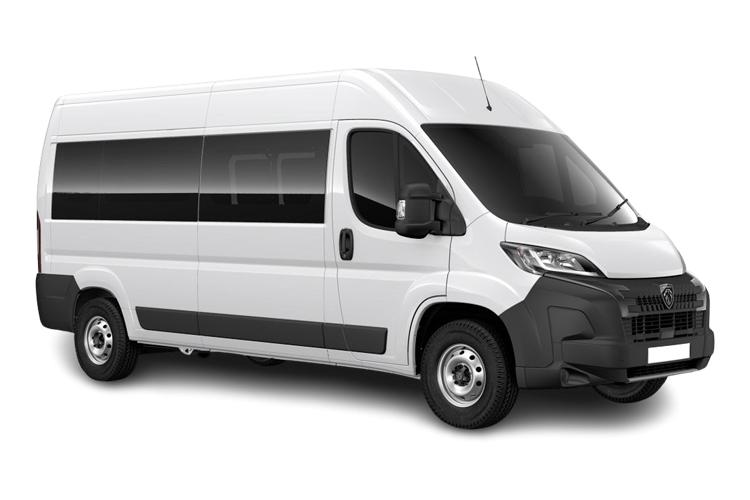
Images are for illustrative purposes only.
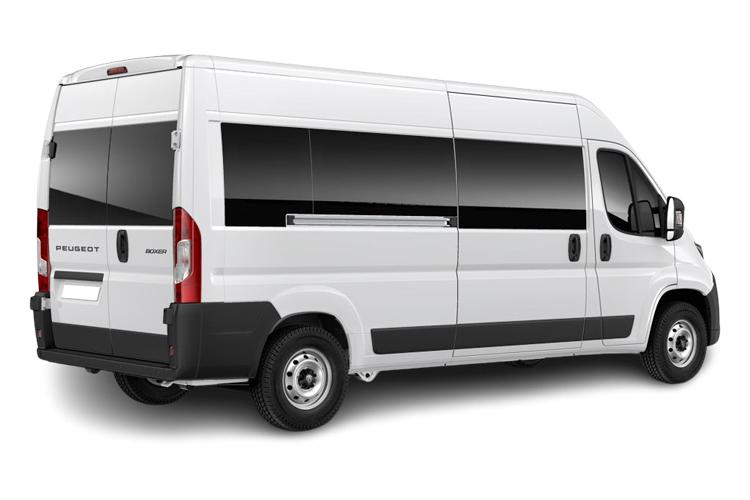

200kW 110kWh H2 Glazed Van Professional Auto
Need some assistance or advice? Call Us 01903 538835


Peugeot's enhanced E-Boxer brings offers a much improved EV drivetrain to suit businesses wanting a large electric van. Jonathan Crouch drives it.
Peugeot's largest EV van is this one, the E-Boxer. And in this usefully updated form, it's well worth a second look because it now has a considerably larger battery and a much more powerful electric motor. Peugeot's also given this LCV a sharper look and a more modern interior. Plus it can take heavier loads too.
Peugeot was certainly quick to market with this EV version of its large LCV, the Boxer. That electric model was first introduced in 2020, but never initially sold in very large numbers because of its high price, feeble pulling power and restricted EV range. Forget about all of that now because this revised version, introduced early in 2024, is much better, vastly improved in all of these key areas. It now has the same 110kWh powertrain as is also used by the Citroen e-Relay, the Vauxhall Movano Electric, the Fiat E-Ducato and the Toyota Proace Max Electric. And much the same engineering. So why should you choose the Peugeot version? Let's see.
The big news with this updated E-Boxer is its larger 110kWh battery, which (depending on variant) takes you between 235 and 263 miles between charges (up from 154 miles with the old 75kWh model), though that'll drop a bit if you've a full load out back. Almost equally important is the installation of a gutsier 270hp electric motor to drive the front wheels (up from just 122hp before), which has boosted pulling power from the previous feeble 260Nm to a much more usable 410Nm. There are strange-looking push-button controls for the single-speed gearbox, but the starting procedure's straightforward. Unlike other EV vans, the surge of power you get at the wheel of this one is rather gradual. The performance and range of this improved E-Boxer can be optimised depending on conditions thanks to three driving modes, and features paddles located just behind the steering wheel that activate four levels of regenerative deceleration. The steering's quite a old-fashioned set-up that's quite heavy at low speeds, but lightens up at faster ones. Whatever E-Boxer variant you select, around town, this van can make light work of tricky urban situations; the 'L3H2' variant offers a relatively tight 14.14m turning circle between kerbs.
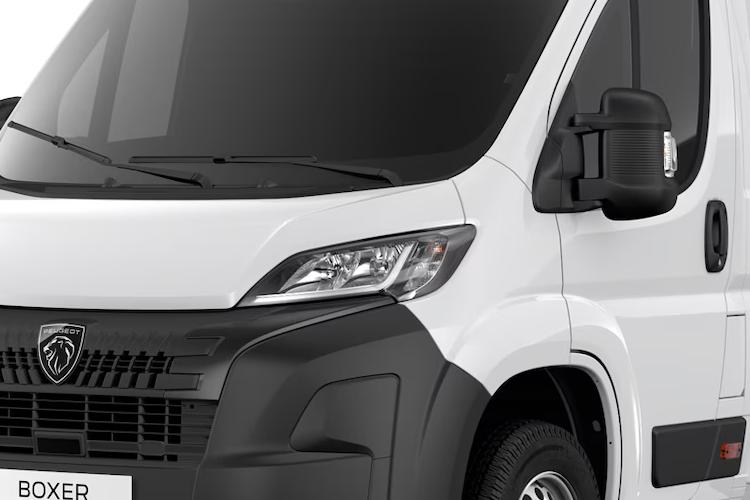
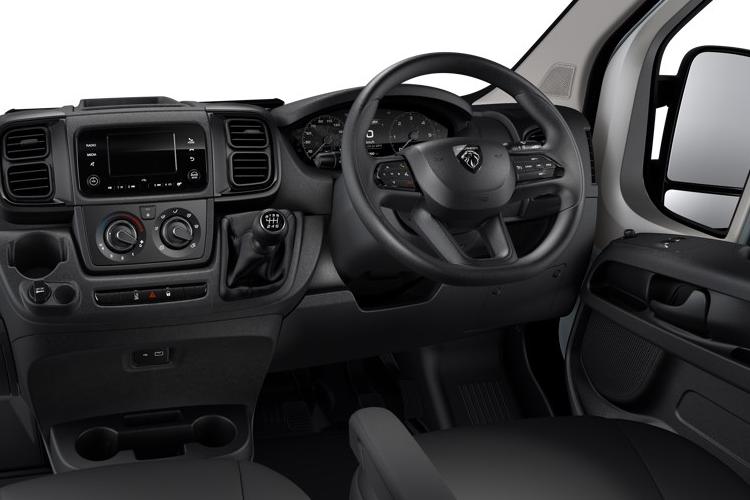
Your customers are unlikely to guess that with this van, your company has switched to a full-EV for deliveries. Apart from the badging and the charging flap, there are no exterior giveaways to this e-Boxer's electric status. In this updated form, the E-Boxer features the latest Peugeot brand shield logo and gets a redesigned front bumper, revised rear-view mirrors and a smarter body-colour grille incorporating automatically controlled sections to regulate airflow. The E-Boxer also gains full-LED front headlights and redesigned rear lights. As before, there are two body styles - Panel and Window van. The Panel and Window van can be specified in three lengths (L2, L3 and L4) and three heights for the Panel van (two in the Window van). The Panel van offers loadspace options between 8m3 and 17m3. Climb inside and you'll be greeted by decent quality cab trim and now more modern dashboard layout. The interior of this updated model has been extensively overhauled with fresh design for the steering wheel, dashboard, seat fabrics and door panels. Infotainment is now provided by a 10-inch touchscreen with 'Apple CarPlay', 'Android Auto' and 3D Connected Navigation. Automatic climate control, a wireless phone charger and keyless entry and start provide greater comfort and convenience. As you'd expect, there's a dual passenger seat, this one incorporating a drop-down desk unit. Up to ten in-cab storage areas are available, including the glovebox, a dash-mounted document clip and various open or lidded compartments on the dashboard. In addition, there are large door pockets, storage space beneath the passenger seat and a sizeable 22-litre overhead storage compartment. There's been a clear effort in design here not just to improve the perception of quality in the cab but also to beef up high use, high stress items such as the rear doors. These have been reinforced and high strength door hinges are used. Similarly, the sliding side load door gets reinforced rails, tough-design runners and security-tested door locks.
Prices, as you'd expect, are much the same as those being charged for the Vauxhall Movano Electric, Citroen e-Relay, Fiat E-Ducato and Toyota Proace Max Electric models that share this Peugeot's engineering. That means that without VAT and after deduction of the government's £5,000 Plug-in Van Grant, you're looking at starting figures beginning at just under £46,000 on the road for the L3H2 version (about £12,000 more than the equivalent manual diesel version). Add about £1,600 more for the lengthier L4H2 variant. There's only one 110kWh battery option - and only one trim level ('Professional') too. At least your business will get a reasonable amount of kit for its money. Every model features Bluetooth with a USB input, a full steel buckhead and deadlocks. Plus air conditioning, an alarm, cruise control with a speed limiter, a rear parking aid and a 10-inch colour central touchscreen. This monitor allows the operation of all functions, such as audio streaming, reading SMS text messages and an integrated satellite navigation system, as well as the display of the image from the reversing camera. Safety inclusions across the range run to anti-lock brakes, a driver's airbag and ESP electronic stability control with emergency braking assistance. There's also various storage areas, as well as a document holder and writing table built into the folding backrest of the centre seat. Key options include a spare wheel, a passenger airbag and 270-degree opening rear doors.
On to practicalities. You get a choice of two roof heights with the E-Boxer - H2 and H3. Body lengths are limited to the longer L3 and L4 models. There's now a heavy duty version, so payload isn't quite so limited as it was before. 1,385kg will be the most you can carry - compared to 2-tonnes in the diesel variant. That's better than a Mercedes eSprinter. But Peugeot shouldn't congratulate itself. In contrast, the distantly-related Fiat E-Ducato can take up to 1,570kgs. Outside the Stellantis Group, other rivals can easily better this Peugeot's payload showing too. Load capacity figures are the same as with a diesel-powered Boxer. That's because the drive system's lithium-ion battery is mounted under the floor between the front and rear axle and so doesn't impinge on the cargo bay. In L3 configuration, the E-Boxer has a load deck length of 3705mm and an internal load height of 1932mm, which gives a 13m3 capacity. The largest E-Boxer L4 has a load deck length of 4070mm and a 17.0m3 capacity. We gave you the range figures - 235-263 miles - in our Driving section (up from 154 miles previously). The E-Boxer is now fitted as standard with a 22kW onboard charger. As a result, a full charge from an 11kW AC charger will take 6 hours 5 minutes. While using a 150kW DC rapid charging point, 55 minutes is enough to charge the battery to 80%. Like Peugeot's other fully electric LCV models, the E-Boxer is exempt from current ultra-low and congestion charge payments. The zero emissions powertrain also allows businesses to save significantly on company van tax, with a 0% Benefit-in-Kind tax rate. This provides eligible businesses with immediate and significant annual savings that can amount to thousands of pounds.
It's a pity that this heavily improved version of the E-Boxer wasn't the one we were offered from the beginning. As it is, this revised model's introduction must be welcome for Peugeot's LCV dealers, who didn't have much luck in shifting the original version of this model in an LCV market that's proved slow to get on board with the EV revolution. Yes, you'll find other near-identically-engineered Stellantis Group large vans that can offer you much the same kind of package. But if your fleet already runs Peugeot vans - and particularly E-Partner and E-Expert models - it would make sense to keep things common and add a few E-Boxers as well. That was the argument before this update of course; now though, it makes just that bit more sense.
Data provided by CAP-HPI database - Ref# 58078
Peugeot's enhanced E-Boxer brings offers a much improved EV drivetrain to suit businesses wanting a large electric van. Jonathan Crouch drives it.
Peugeot's largest EV van is this one, the E-Boxer. And in this usefully updated form, it's well worth a second look because it now has a considerably larger battery and a much more powerful electric motor. Peugeot's also given this LCV a sharper look and a more modern interior. Plus it can take heavier loads too.
Peugeot was certainly quick to market with this EV version of its large LCV, the Boxer. That electric model was first introduced in 2020, but never initially sold in very large numbers because of its high price, feeble pulling power and restricted EV range. Forget about all of that now because this revised version, introduced early in 2024, is much better, vastly improved in all of these key areas. It now has the same 110kWh powertrain as is also used by the Citroen e-Relay, the Vauxhall Movano Electric, the Fiat E-Ducato and the Toyota Proace Max Electric. And much the same engineering. So why should you choose the Peugeot version? Let's see.
The big news with this updated E-Boxer is its larger 110kWh battery, which (depending on variant) takes you between 235 and 263 miles between charges (up from 154 miles with the old 75kWh model), though that'll drop a bit if you've a full load out back. Almost equally important is the installation of a gutsier 270hp electric motor to drive the front wheels (up from just 122hp before), which has boosted pulling power from the previous feeble 260Nm to a much more usable 410Nm. There are strange-looking push-button controls for the single-speed gearbox, but the starting procedure's straightforward. Unlike other EV vans, the surge of power you get at the wheel of this one is rather gradual. The performance and range of this improved E-Boxer can be optimised depending on conditions thanks to three driving modes, and features paddles located just behind the steering wheel that activate four levels of regenerative deceleration. The steering's quite a old-fashioned set-up that's quite heavy at low speeds, but lightens up at faster ones. Whatever E-Boxer variant you select, around town, this van can make light work of tricky urban situations; the 'L3H2' variant offers a relatively tight 14.14m turning circle between kerbs.
Your customers are unlikely to guess that with this van, your company has switched to a full-EV for deliveries. Apart from the badging and the charging flap, there are no exterior giveaways to this e-Boxer's electric status. In this updated form, the E-Boxer features the latest Peugeot brand shield logo and gets a redesigned front bumper, revised rear-view mirrors and a smarter body-colour grille incorporating automatically controlled sections to regulate airflow. The E-Boxer also gains full-LED front headlights and redesigned rear lights. As before, there are two body styles - Panel and Window van. The Panel and Window van can be specified in three lengths (L2, L3 and L4) and three heights for the Panel van (two in the Window van). The Panel van offers loadspace options between 8m3 and 17m3. Climb inside and you'll be greeted by decent quality cab trim and now more modern dashboard layout. The interior of this updated model has been extensively overhauled with fresh design for the steering wheel, dashboard, seat fabrics and door panels. Infotainment is now provided by a 10-inch touchscreen with 'Apple CarPlay', 'Android Auto' and 3D Connected Navigation. Automatic climate control, a wireless phone charger and keyless entry and start provide greater comfort and convenience. As you'd expect, there's a dual passenger seat, this one incorporating a drop-down desk unit. Up to ten in-cab storage areas are available, including the glovebox, a dash-mounted document clip and various open or lidded compartments on the dashboard. In addition, there are large door pockets, storage space beneath the passenger seat and a sizeable 22-litre overhead storage compartment. There's been a clear effort in design here not just to improve the perception of quality in the cab but also to beef up high use, high stress items such as the rear doors. These have been reinforced and high strength door hinges are used. Similarly, the sliding side load door gets reinforced rails, tough-design runners and security-tested door locks.
Prices, as you'd expect, are much the same as those being charged for the Vauxhall Movano Electric, Citroen e-Relay, Fiat E-Ducato and Toyota Proace Max Electric models that share this Peugeot's engineering. That means that without VAT and after deduction of the government's £5,000 Plug-in Van Grant, you're looking at starting figures beginning at just under £46,000 on the road for the L3H2 version (about £12,000 more than the equivalent manual diesel version). Add about £1,600 more for the lengthier L4H2 variant. There's only one 110kWh battery option - and only one trim level ('Professional') too. At least your business will get a reasonable amount of kit for its money. Every model features Bluetooth with a USB input, a full steel buckhead and deadlocks. Plus air conditioning, an alarm, cruise control with a speed limiter, a rear parking aid and a 10-inch colour central touchscreen. This monitor allows the operation of all functions, such as audio streaming, reading SMS text messages and an integrated satellite navigation system, as well as the display of the image from the reversing camera. Safety inclusions across the range run to anti-lock brakes, a driver's airbag and ESP electronic stability control with emergency braking assistance. There's also various storage areas, as well as a document holder and writing table built into the folding backrest of the centre seat. Key options include a spare wheel, a passenger airbag and 270-degree opening rear doors.
On to practicalities. You get a choice of two roof heights with the E-Boxer - H2 and H3. Body lengths are limited to the longer L3 and L4 models. There's now a heavy duty version, so payload isn't quite so limited as it was before. 1,385kg will be the most you can carry - compared to 2-tonnes in the diesel variant. That's better than a Mercedes eSprinter. But Peugeot shouldn't congratulate itself. In contrast, the distantly-related Fiat E-Ducato can take up to 1,570kgs. Outside the Stellantis Group, other rivals can easily better this Peugeot's payload showing too. Load capacity figures are the same as with a diesel-powered Boxer. That's because the drive system's lithium-ion battery is mounted under the floor between the front and rear axle and so doesn't impinge on the cargo bay. In L3 configuration, the E-Boxer has a load deck length of 3705mm and an internal load height of 1932mm, which gives a 13m3 capacity. The largest E-Boxer L4 has a load deck length of 4070mm and a 17.0m3 capacity. We gave you the range figures - 235-263 miles - in our Driving section (up from 154 miles previously). The E-Boxer is now fitted as standard with a 22kW onboard charger. As a result, a full charge from an 11kW AC charger will take 6 hours 5 minutes. While using a 150kW DC rapid charging point, 55 minutes is enough to charge the battery to 80%. Like Peugeot's other fully electric LCV models, the E-Boxer is exempt from current ultra-low and congestion charge payments. The zero emissions powertrain also allows businesses to save significantly on company van tax, with a 0% Benefit-in-Kind tax rate. This provides eligible businesses with immediate and significant annual savings that can amount to thousands of pounds.
It's a pity that this heavily improved version of the E-Boxer wasn't the one we were offered from the beginning. As it is, this revised model's introduction must be welcome for Peugeot's LCV dealers, who didn't have much luck in shifting the original version of this model in an LCV market that's proved slow to get on board with the EV revolution. Yes, you'll find other near-identically-engineered Stellantis Group large vans that can offer you much the same kind of package. But if your fleet already runs Peugeot vans - and particularly E-Partner and E-Expert models - it would make sense to keep things common and add a few E-Boxers as well. That was the argument before this update of course; now though, it makes just that bit more sense.
