Images are for illustrative purposes only.

245kW SM Extended Range Ultra 92kWh 5dr Auto
Need some assistance or advice? Call Us 01903 538835


The ES90 is a new kind of large electric Volvo. Jonathan Crouch drives it.
Here's a very different kind of Volvo saloon, the ES90. Derived from the big EX90 electric SUV but a step further on technology, this large electric sedan/fastback offers something interestingly different in the evolving market for premium brand luxury EVs. And it breaks new technology boundaries for Volvo.
Essentially, this car is the spiritual successor to the Gothenburg maker's most recent combustion big saloon, the S90 (sold between 2016 and 2024). The ES90 has five doors, but as part of a chunky silhouette that's supposed to combine the genres of sedan, fastback and SUV, putting it (according to Volvo) 'fully in a class of its own'. Once defined by safety, this Swedish maker is now apparently a brand defined by computing power. The company now describes itself as 'an industry leader in software-defined cars' and back in 2025 at the launch of this car, claimed that this model was the most powerful model it had yet created in terms of core computing capacity. It was the first electric Volvo to use a properly cutting-edge 800V electrical architecture (since adopted by its identically-engineered EX90 SUV stablemate) - the kind of thing that will allow super-quick charging from the new breed of ultra-fast DC chargers springing up around Europe. That gives it an advantage over two class rivals - the BMW i5 and the Mercedes EQE - but not over another, the Audi A6 e-tron. And since Volvo hasn't been shy about pricing the ES90 against these rivals, this car will need to be very good indeed. Is it? Let's find out.
Driving this car is a very serene experience, especially in a version fitted, like this test car, with Volvo's 'Active Four-C' Chassis dual-chamber air suspension set-up, which wafts you over poor surfaces. The perfect accompaniment to this ES90's exemplary refinement. All electric cars are pretty quiet, but the brand has gone to extraordinary lengths to make this one especially silent. Thanks in part to the sleekest shape of any Volvo yet made (0.25Cd), the Gothenburg marque says it's created the quietest-ever cabin of any model in its history. Three powertrains are available, starting with the Single Motor Extended Range model, which features a rear-mounted 333hp e-motor developing 480Nm of torque, propelling this big saloon to 62mph in 6.6s. Energy comes from the smaller of the two available batteries, a 'Standard Range' 92kWh unit (88kWh of which is usable) that nonetheless offers up to 412.6 miles of range. If, for reasons we're not quite sure we understand, you want your ES90 with a Twin Motor AWD powertrain, then the heavier provision of a motor on each axle means the need for a larger 106kWh battery (102kWh of which is usable). The added motor on the front axle boosts total output to 456hp with 670Nm of torque, which improves the 0-62mph sprint time to 5.4s. Range is up to 432.5 miles. As it is for the top 'Twin Motor Performance' flagship model, which has power output upgraded to 680hp and 870Nm - enough to get the car to 62mph in 4s flat.
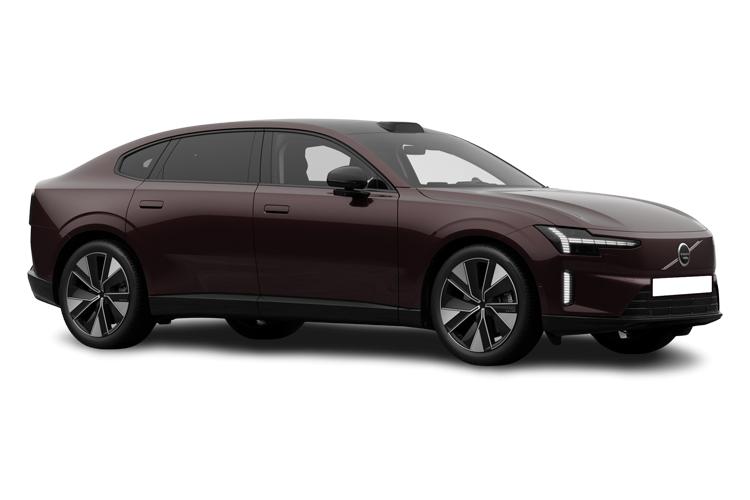
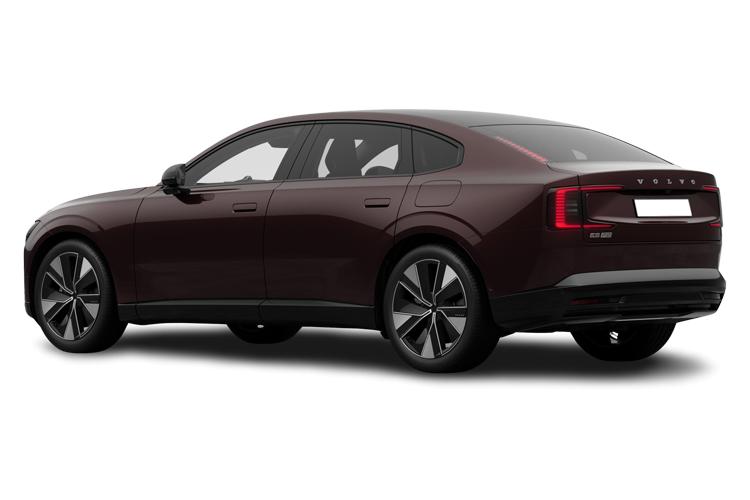
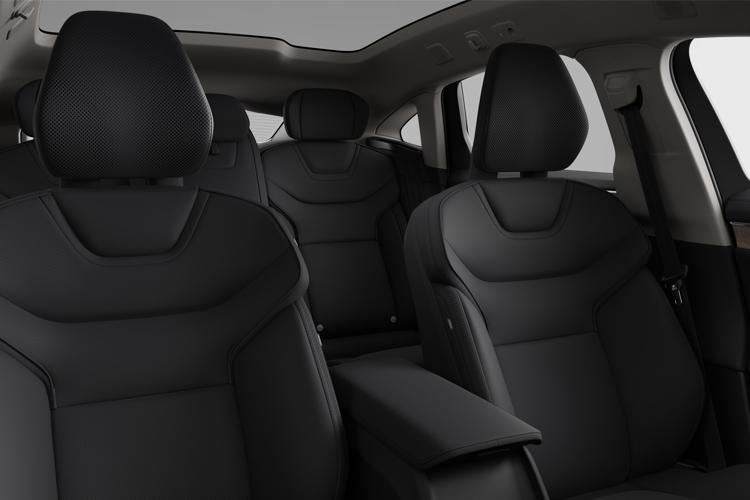
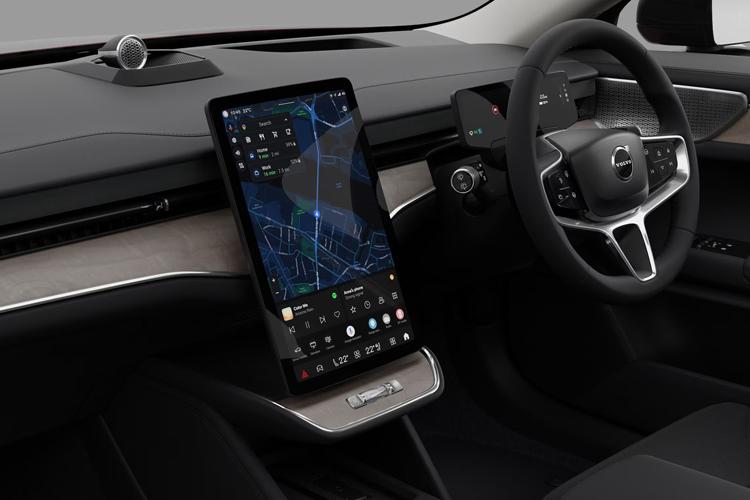
The ES90 adopts what Volvo calls 'a new vernacular' for what a premium large saloon should be. At around 5-metres in length, it could be larger - and some competitors are - but it doesn't have to be because with no need for huge engine up-front, the longer wheelbase length (3.1m) can be devoted to a generously-sized cabin. Though marketed primarily as a sedan (despite the fact it has five doors), there are fastback and SUV genes in the elegant shape, as part of a design language supposed to look solid and technology-led. The styling ethos is supposed to echo that of a modern Apple MacBook - something machined from a block of aluminium rather than pressed from sheet metal. You feel that very much at the front, where there's the latest version of Volvo's 'Thor's Hammer' headlight motif. The rear has C-shaped LED tail lamps that reference those of this model's S90 predecessor. More unusually, further up are slatted vertical lamps that peep out of the tailgate window edges, which from way off can almost make the ES90 look like an estate; there won't be an estate body shape by the way. Wheel sizes are 20 or 21-inches and the drag coefficient is slippery at 0.25Cd. This is supposed to be the most aerodynamic Volvo model in history. Things are rather less unique inside, where the ES90 carries over much the same front-of-cabin design as debited in the EX90. But there's a cleaner centre console and that SUV model's tall centre tunnel has been replaced by a lower, more open design. It's all very 'Volvo', with reclaimed Birch Wood inlays on the dash, the centre console and around the crystal volume controller below the centre screen. Plus the brand's usual frameless rear view and door mirrors. Lots of effort's gone into premium materials and soft touch points. And if you get a this 'Ultra'-spec model with its perforated Nordico upholstery and the intricate speaker grilles and central 'jet engine'-style dash-top speaker of the upgraded Bowers & Wilkins audio system, it really does feel very high-end. The screen tech is of course the same as in the EX90, which means a digital instrument cluster that can be relatively small (at 9-inches) because it's complemented by a head-up display. It's a simple set-up prioritising either nav mapping or a drive assist graphic, depending on your preference. Just about all the switchgear has been replaced by a huge Tesla-like 14.5-inch central portrait touchscreen. Rear seat space, predictably, is noticeably better than that provided by the old S90. And there are 'luxury'-spec rear seats that feature a lounge armrest and can be individually and electrically reclined. Boot space is rated at 424-litres - or 1,256-litres with the back seats folded. Plus there's a 22-litre under-bonnet 'frunk'.
Prices start from around £67,500 for the base 'Plus' version and range up to around £86,000 for the top version of the plusher 'Ultra' model; that's similar to many German rivals and only a little less than Volvo's EX90 SUV. As we've told you, there are three different models - Single Motor Extended Range, Twin Motor and Twin Motor Performance. And there are seven paint colours to choose from. And four different wheel options ranging from 20 to 22-inches in diameter. Base 'Plus' trim comes only with the base Single Motor Standard Range powertrain, with standard kit including the various cabin screens, a 360-degree 3D camera system, 20-inch wheels, a Bose premium stereo and an energy-saving heat pump, along with a whole portfolio of driver assistance features. You might hope for leather upholstery from a car of this price, but that wouldn't be very eco-friendly, so instead the seats are clad in recycled fabric. And customers will be able to open their ES90 from their smartphone using a digital key. Infotainment benefits from over-the-air updates and is based on an evolution of the company's Google software. It includes a variety of Google apps and offers 5G connectivity, along with the usual wireless 'Apple CarPlay' and 'Android Auto' compatibility. Media connectivity is powerful, thanks to a combination of Snapdragon computing power and the 'Unreal Engine 5 graphics' tech lately used by the gaming industry Plusher 'Ultra' trim adds Pixel LED headlights, an upgraded 'Active Four-C' Chassis with air suspension, bigger 21-inch wheels, electrochromic functionality for the glass roof and laminated side and rear glass. Inside, there's nicer Nordico upholstery and all-round ventilated seats that have a massaging function in the front, plus powered rear seat backrest recline, a rear seat lounge armrest, dark rear tinted windows and power-closing doors. 'Ultra' spec also includes an even higher quality sound system - a Bowers and Wilkins set-up with 25 speakers and a thumping 1,610-watt output.
Unlike its EX90 showroom stablemate, the ES90 has always featured cutting-edge 800V electrical architecture, which allows it to offer super-fast 350kW rapid charging. If you can find a public charger offering that, then with either the 92kWh battery or the 106kWh battery, a 10-80% DC charge will need 22 minutes. When DC charging, you'll probably be using a range of different public chargers, so the brand has developed a multi-high-speed charging system that allows switching between 800 volt and 400 volt outputs. At home using a single-phase 7.4kW AC wallbox, a full charge of the 92kWh battery needs 14 hours - it's 16 hours for the 102kWh battery. You can improve these times to 9 hours and 10 hours respectively if you're able to use an 11kW AC wallbox with a three-phase supply. What else? Well there's the usual EV low Benefit-in-Kind tax rating - at 4% until Spring 2027 at the time of our test. Which you'll need to compensate for the fact that every ES90 is highly rated for insurance. It's group 44 for the Single Motor Extended Range model; it's group 47 for the Twin Motor version and group 50 for the Twin Motor Performance model. Like all owners in this segment, ES90 customers must also budget for the government's Luxury Car Tax, a supplementary fee on top of the standard rate of Vehicle Excise Duty chargeable from the second time the car is taxed until it is six years old. Residual values are some way behind those of a comparable EX90 SUV - and behind more direct rivals too, rated at between 43-45% after three years and 36,000 miles. The warranty is the usual unremarkable three year / 60,000 mile Volvo package; and as you would expect with an EV, the battery is covered by its own eight year 99,000 mile warranty.
The Swedish maker reckons that the ES90 is 'a true premium Volvo car designed to elevate your quality of life'. Perhaps. Given that target customers are likely to be from an older demographic, we're not sure that all of them will be that enthusiastic about the idea of 'a software-defined' Volvo. But if you don't mind that and want to switch to a rather different kind of premium brand large luxury EV, then there's lots to like here, regardless of whether you see the ES90 as a saloon, a fastback or even some sort of crossover. It'll certainly have wider market appeal than the rather frumpy old S90. Volvo's EV journey, it seems, has finally started in earnest. It'll be interesting to see where it takes them.
Data provided by CAP-HPI database - Ref# 108812
The ES90 is a new kind of large electric Volvo. Jonathan Crouch drives it.
Here's a very different kind of Volvo saloon, the ES90. Derived from the big EX90 electric SUV but a step further on technology, this large electric sedan/fastback offers something interestingly different in the evolving market for premium brand luxury EVs. And it breaks new technology boundaries for Volvo.
Essentially, this car is the spiritual successor to the Gothenburg maker's most recent combustion big saloon, the S90 (sold between 2016 and 2024). The ES90 has five doors, but as part of a chunky silhouette that's supposed to combine the genres of sedan, fastback and SUV, putting it (according to Volvo) 'fully in a class of its own'. Once defined by safety, this Swedish maker is now apparently a brand defined by computing power. The company now describes itself as 'an industry leader in software-defined cars' and back in 2025 at the launch of this car, claimed that this model was the most powerful model it had yet created in terms of core computing capacity. It was the first electric Volvo to use a properly cutting-edge 800V electrical architecture (since adopted by its identically-engineered EX90 SUV stablemate) - the kind of thing that will allow super-quick charging from the new breed of ultra-fast DC chargers springing up around Europe. That gives it an advantage over two class rivals - the BMW i5 and the Mercedes EQE - but not over another, the Audi A6 e-tron. And since Volvo hasn't been shy about pricing the ES90 against these rivals, this car will need to be very good indeed. Is it? Let's find out.
Driving this car is a very serene experience, especially in a version fitted, like this test car, with Volvo's 'Active Four-C' Chassis dual-chamber air suspension set-up, which wafts you over poor surfaces. The perfect accompaniment to this ES90's exemplary refinement. All electric cars are pretty quiet, but the brand has gone to extraordinary lengths to make this one especially silent. Thanks in part to the sleekest shape of any Volvo yet made (0.25Cd), the Gothenburg marque says it's created the quietest-ever cabin of any model in its history. Three powertrains are available, starting with the Single Motor Extended Range model, which features a rear-mounted 333hp e-motor developing 480Nm of torque, propelling this big saloon to 62mph in 6.6s. Energy comes from the smaller of the two available batteries, a 'Standard Range' 92kWh unit (88kWh of which is usable) that nonetheless offers up to 412.6 miles of range. If, for reasons we're not quite sure we understand, you want your ES90 with a Twin Motor AWD powertrain, then the heavier provision of a motor on each axle means the need for a larger 106kWh battery (102kWh of which is usable). The added motor on the front axle boosts total output to 456hp with 670Nm of torque, which improves the 0-62mph sprint time to 5.4s. Range is up to 432.5 miles. As it is for the top 'Twin Motor Performance' flagship model, which has power output upgraded to 680hp and 870Nm - enough to get the car to 62mph in 4s flat.
The ES90 adopts what Volvo calls 'a new vernacular' for what a premium large saloon should be. At around 5-metres in length, it could be larger - and some competitors are - but it doesn't have to be because with no need for huge engine up-front, the longer wheelbase length (3.1m) can be devoted to a generously-sized cabin. Though marketed primarily as a sedan (despite the fact it has five doors), there are fastback and SUV genes in the elegant shape, as part of a design language supposed to look solid and technology-led. The styling ethos is supposed to echo that of a modern Apple MacBook - something machined from a block of aluminium rather than pressed from sheet metal. You feel that very much at the front, where there's the latest version of Volvo's 'Thor's Hammer' headlight motif. The rear has C-shaped LED tail lamps that reference those of this model's S90 predecessor. More unusually, further up are slatted vertical lamps that peep out of the tailgate window edges, which from way off can almost make the ES90 look like an estate; there won't be an estate body shape by the way. Wheel sizes are 20 or 21-inches and the drag coefficient is slippery at 0.25Cd. This is supposed to be the most aerodynamic Volvo model in history. Things are rather less unique inside, where the ES90 carries over much the same front-of-cabin design as debited in the EX90. But there's a cleaner centre console and that SUV model's tall centre tunnel has been replaced by a lower, more open design. It's all very 'Volvo', with reclaimed Birch Wood inlays on the dash, the centre console and around the crystal volume controller below the centre screen. Plus the brand's usual frameless rear view and door mirrors. Lots of effort's gone into premium materials and soft touch points. And if you get a this 'Ultra'-spec model with its perforated Nordico upholstery and the intricate speaker grilles and central 'jet engine'-style dash-top speaker of the upgraded Bowers & Wilkins audio system, it really does feel very high-end. The screen tech is of course the same as in the EX90, which means a digital instrument cluster that can be relatively small (at 9-inches) because it's complemented by a head-up display. It's a simple set-up prioritising either nav mapping or a drive assist graphic, depending on your preference. Just about all the switchgear has been replaced by a huge Tesla-like 14.5-inch central portrait touchscreen. Rear seat space, predictably, is noticeably better than that provided by the old S90. And there are 'luxury'-spec rear seats that feature a lounge armrest and can be individually and electrically reclined. Boot space is rated at 424-litres - or 1,256-litres with the back seats folded. Plus there's a 22-litre under-bonnet 'frunk'.
Prices start from around £67,500 for the base 'Plus' version and range up to around £86,000 for the top version of the plusher 'Ultra' model; that's similar to many German rivals and only a little less than Volvo's EX90 SUV. As we've told you, there are three different models - Single Motor Extended Range, Twin Motor and Twin Motor Performance. And there are seven paint colours to choose from. And four different wheel options ranging from 20 to 22-inches in diameter. Base 'Plus' trim comes only with the base Single Motor Standard Range powertrain, with standard kit including the various cabin screens, a 360-degree 3D camera system, 20-inch wheels, a Bose premium stereo and an energy-saving heat pump, along with a whole portfolio of driver assistance features. You might hope for leather upholstery from a car of this price, but that wouldn't be very eco-friendly, so instead the seats are clad in recycled fabric. And customers will be able to open their ES90 from their smartphone using a digital key. Infotainment benefits from over-the-air updates and is based on an evolution of the company's Google software. It includes a variety of Google apps and offers 5G connectivity, along with the usual wireless 'Apple CarPlay' and 'Android Auto' compatibility. Media connectivity is powerful, thanks to a combination of Snapdragon computing power and the 'Unreal Engine 5 graphics' tech lately used by the gaming industry Plusher 'Ultra' trim adds Pixel LED headlights, an upgraded 'Active Four-C' Chassis with air suspension, bigger 21-inch wheels, electrochromic functionality for the glass roof and laminated side and rear glass. Inside, there's nicer Nordico upholstery and all-round ventilated seats that have a massaging function in the front, plus powered rear seat backrest recline, a rear seat lounge armrest, dark rear tinted windows and power-closing doors. 'Ultra' spec also includes an even higher quality sound system - a Bowers and Wilkins set-up with 25 speakers and a thumping 1,610-watt output.
Unlike its EX90 showroom stablemate, the ES90 has always featured cutting-edge 800V electrical architecture, which allows it to offer super-fast 350kW rapid charging. If you can find a public charger offering that, then with either the 92kWh battery or the 106kWh battery, a 10-80% DC charge will need 22 minutes. When DC charging, you'll probably be using a range of different public chargers, so the brand has developed a multi-high-speed charging system that allows switching between 800 volt and 400 volt outputs. At home using a single-phase 7.4kW AC wallbox, a full charge of the 92kWh battery needs 14 hours - it's 16 hours for the 102kWh battery. You can improve these times to 9 hours and 10 hours respectively if you're able to use an 11kW AC wallbox with a three-phase supply. What else? Well there's the usual EV low Benefit-in-Kind tax rating - at 4% until Spring 2027 at the time of our test. Which you'll need to compensate for the fact that every ES90 is highly rated for insurance. It's group 44 for the Single Motor Extended Range model; it's group 47 for the Twin Motor version and group 50 for the Twin Motor Performance model. Like all owners in this segment, ES90 customers must also budget for the government's Luxury Car Tax, a supplementary fee on top of the standard rate of Vehicle Excise Duty chargeable from the second time the car is taxed until it is six years old. Residual values are some way behind those of a comparable EX90 SUV - and behind more direct rivals too, rated at between 43-45% after three years and 36,000 miles. The warranty is the usual unremarkable three year / 60,000 mile Volvo package; and as you would expect with an EV, the battery is covered by its own eight year 99,000 mile warranty.
The Swedish maker reckons that the ES90 is 'a true premium Volvo car designed to elevate your quality of life'. Perhaps. Given that target customers are likely to be from an older demographic, we're not sure that all of them will be that enthusiastic about the idea of 'a software-defined' Volvo. But if you don't mind that and want to switch to a rather different kind of premium brand large luxury EV, then there's lots to like here, regardless of whether you see the ES90 as a saloon, a fastback or even some sort of crossover. It'll certainly have wider market appeal than the rather frumpy old S90. Volvo's EV journey, it seems, has finally started in earnest. It'll be interesting to see where it takes them.